





I think I gave my clients a heart attack.
I had just set up a boutique contact centre operation, and one of the rules that we had, and an important rule was something you are about to find out about. I went out to every client and told them they could target me as a company on any KPI they liked, however I would not be targeting our people. Target me, not my people, it is up to me how we manage your KPIs and how we ensure achieving them.
Some of them just looked at me.
It sounded like a stunt, or some bet about measuring outcomes for vulnerable customers, and about whether anybody in the business was equipped to act on what we found.
So, I made them a deal. Give me a month, I said, and what I will show you clearly is the outcomes that you want, and a far higher rate of success than you are getting now. Most of them gave me the month, as they knew me from the past, but one client would not have it. He was not too sure about any of it, so I said we shall move your campaign onto an outcome-based cost model instead, so we can show you how it works. Then we slaughtered all his targets, after which he came round to the idea.
Thirty years in, and that month is still probably the most interesting and useful lesson about vulnerable customers.
When organisations fail them, they have usually caused it themselves, and have usually done it twice. Once in how they managed and developed their people and how they were targeted, and once in the lack of education and training that the people managing them were given.
What average handle time tells an agent to do
Put average handling time on an individual agent and you have told them something, whether you intended to or not. You have told them to get the customer off the phone.
For most conversations, that instruction leaves no visible mark. It is in the vulnerable ones where it does real damage. The person who needs a moment to find the words. The person calling on behalf of their mother, sitting beside them, hearing every word. A clock on the agent is a clock on the one part of the job that must never be rushed.
So I told my clients, do not give me an average handling time target, because that is not what our focus is.
I am not arguing for deleting the metric. Somebody has to forecast, and you cannot staff a contact centre on good intentions. However, the moment a handling time lands on an individual, it stops being a planning number and turns into an instruction, and your people are very good at hearing instructions.
There is a bill for it too. The conversation closed at four minutes instead of seven is often the one that comes back next week, sometimes twice, and a fair number of those conversations were only happening in the first place because something had already broken further upstream.
I have seen the extreme end of this in other people's centres, where teams were driven by brutally rigid KPIs and the retention figures were nothing short of appalling. I would hesitate even to quote them, they were that bad.
What to measure instead of handle time
The regulator has been blunt about how well this is going. Most of the firms in the FCA's review of vulnerable customer outcomes could not show they were monitoring or acting on them effectively.
So, let's start with the obvious one. If someone is ringing in, we need to solve it, and we need to get to the point where they do not ring back. That is first contact resolution, and for a hard conversation it tells you far more than elapsed time ever will.
Then make it mean something. A case can be closed and counted as resolved while the person on the other end is no better off than when they rang. With a vulnerable customer that gap is where the harm sits, so somebody has to decide what resolved really means for them and write it down where a scorecard can see it. The ScorebuddyCX team have gone into the scorecard side of that.
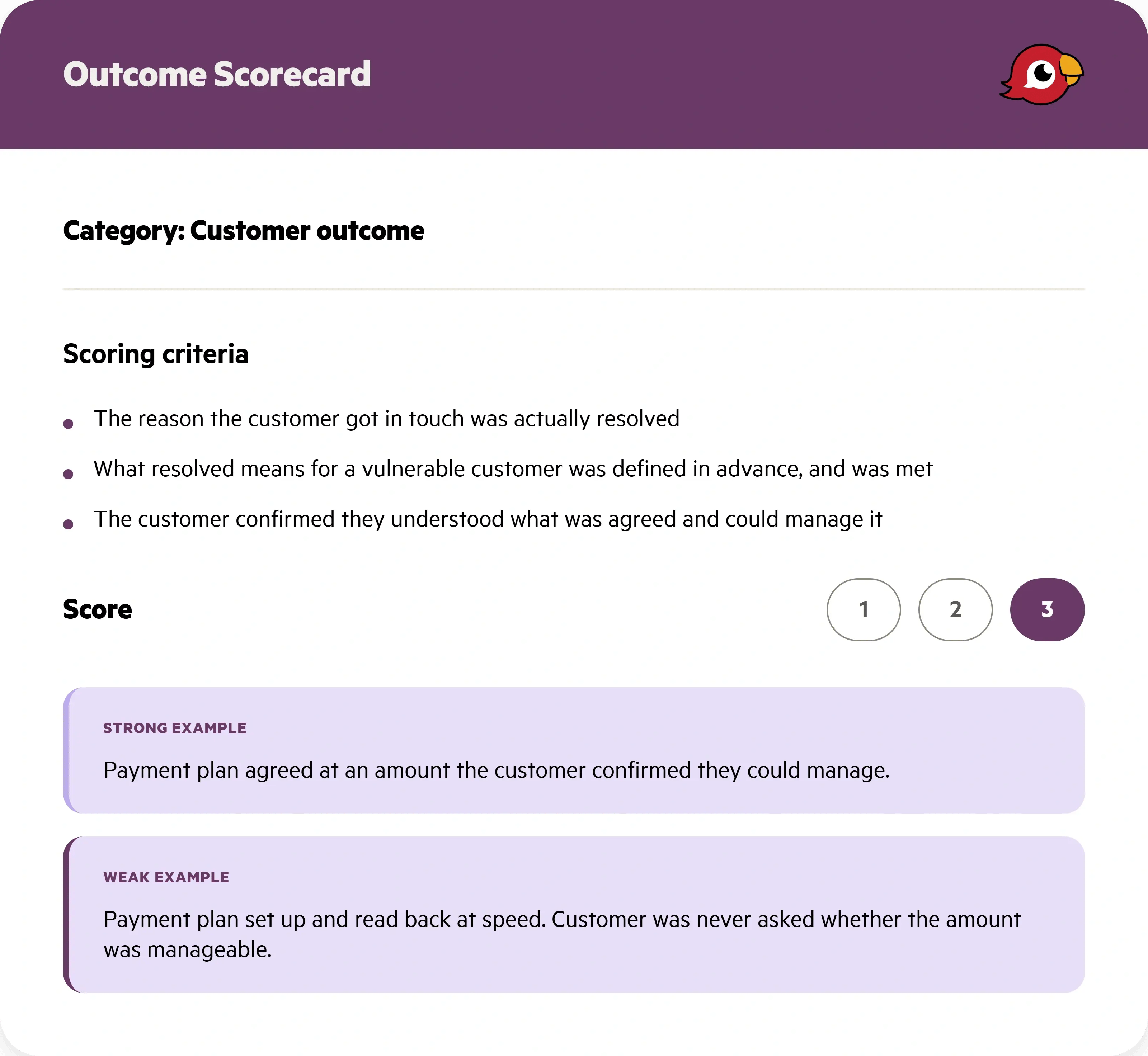
Then the test I would put above all of it, and it comes from the regulator again. Firms should act, the FCA says, where they find any group of retail customers receiving worse outcomes than another group for the same product. Measure your vulnerable customers on their own and the number tells you very little. Measure them against everybody else and you have something you can actually act on, wherever in the world you happen to operate.
I have written elsewhere about the remarkable impact this had on our resolution and quality figures, so I will not revisit it here.
A scorecard cannot sit down with an agent
Change every one of those measures and you have still only done half the job.
A scorecard can tell you that a vulnerable customer was no better off at the end of the conversation. What it cannot do is sit down with the agent and help them understand why. Scoring far more conversations than traditional sampling ever could gives you far better reach, and is how you get evidence about the calls you never hear. But evidence only has value when somebody acts on it.
Then take the clock away and look at what you have done to your managers. For a lot of them, that number was the tool. It was how they ran a one-to-one and how they worked out who to worry about this week. Some will be fine without it. Many were never given anything else.
When I look back at why my own teams performed, the measures are only part of the answer. They were supported in the right way, they were educated, trained, they were coached, nurtured and developed. That is the stuff that never makes it onto a dashboard, and the stuff nobody measures properly.
Nobody invests in team leaders
If you asked me where the biggest gap in this industry sits, I would point at the layer directly above the frontline. Team leaders and team managers, and the education, guidance and support they are given so they can develop and nurture their people consistently. Somebody has to build that capability on purpose, and there are systems that will carry the training and keep it consistent across every team, however the decision to fund any of it comes first. There are some very good employers out there, but there is also an enormous amount still to do, and it has always been like this, which is the part that bothers me.
I have seen it from both ends. Years ago, as site director, I put in a full team leader development programme, proper training and a certification you had to earn before you led a team. Then I left. About seven years later I came back to the same company as a consultant, to work with them through the initial two years after the buyout had gone through. What survived was some very generic HR and recruitment material. All the real important things had disappeared.
Nobody had decided to wreck it, that is the issue about this kind of failure, there is no villain in it anywhere, or is there? HR took ownership of it, after I had gone, with good intentions, but the direction and care needed to come from the top, and it should have stayed as a joint venture between Operations, Training, and Quality & Compliance. However, it was not, and it was just not protected, and one change after another and time went by, and it was diluted more and more.
Think about what an undeveloped team leader/manager does when a vulnerable customer conversation goes wrong. They cannot coach the call, because nobody taught them how to coach, well they will try as they want to help, but it will be their way, their opinion, which could be right, or has a good chance of being wrong. And then the agent who begins to run out of steam, will not spot it either, because spotting that is a skill and skills have to be taught. So, they reach for the one lever anybody ever handed them, which is the target. And we are straight back where we started.
Direct, guide, support, or delegate
Much of my leadership work over the years has been grounded in situational leadership. At its heart is one simple but powerful question: what does this person need from me right now? Clear direction? Practical guidance? Support and encouragement? Or the trust and freedom to take ownership while I step back?
The part people miss is that the answer is not one setting per person. A person is not a team, but they are part of a team, they are an individual within a team, and each individual is made up of all sorts of different elements. You might delegate most of somebody's work quite happily while there are still one or two things they need guidance and support on.
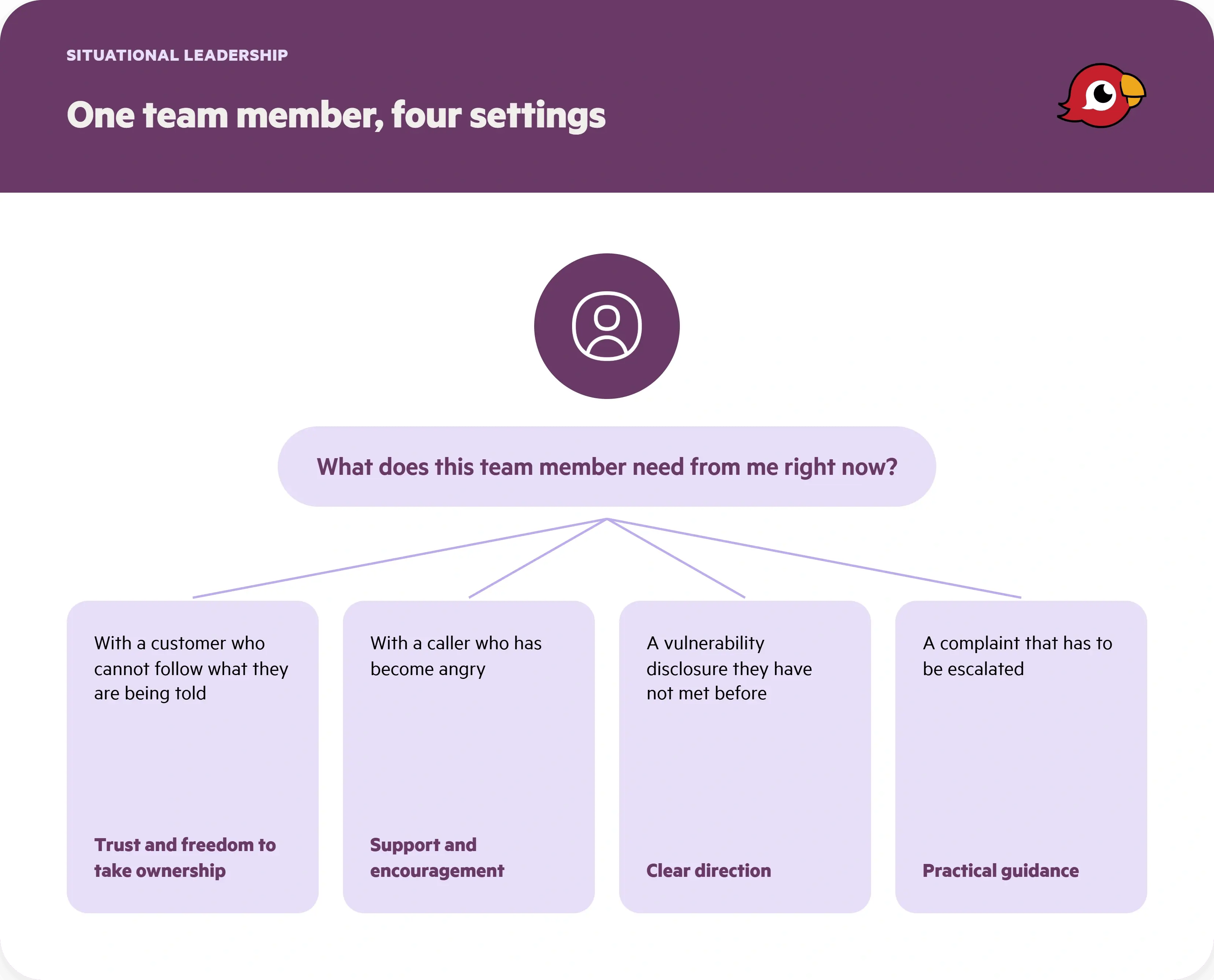
Now put a vulnerable customer conversation in the middle of that. The agent who will take all the time in the world with someone who cannot follow what they are being told, and then tightens up the moment a caller gets angry with them, does not need another training course. They need a leader who knows which is which and adjusts on the day.
That knowledge does not come off a dashboard. It comes from being close enough to your people to notice. I knew every individual in my teams, and if somebody walked in of a morning and there was just something different, I knew about it immediately, because I could tell. No amount of technology is replacing the leader who notices that someone is not quite themselves.
Which is why the one-to-ones matter. A good one is not a status report. You can trend the sickness and the lateness and watch a pattern forming weeks before anybody would have raised it out loud, and the rest of the time you are simply close enough to catch the thing that was never going to come up in a team meeting.
I was completely open with my teams about how the company worked, including the financial model. That transparency created a level of belief and commitment I have rarely seen since. They did not simply deliver. They went above and beyond, achieving extraordinary things for a client many others would have found incredibly difficult to work with.
Tools help with the mechanics. Coaching that runs off the conversations themselves gives a team leader/manager something concrete to work from instead of a number they have to interpret. The judgement stays theirs.
What your team leaders have to lead with
Managers lean on AHT because, for years, it is what we gave them. We made it the measure, the language and the safety net. That is the part we did to ourselves. And it is the part we can undo.
Take the individual target away. But do not stop there. Look closely at what the people you have asked to lead were actually taught and equipped to do, because that is what they will fall back on when the next difficult conversation goes wrong.
Remove the target without replacing it with something better and nothing really changes. The frontline simply ends up being managed through instinct, pressure and guesswork.
So fund the alternative properly. Teach team leaders how to coach. Give them enough time with their people to understand who needs direction, who needs guidance, who needs support and who needs the freedom to get on with it.
Then, when an agent handles the hardest conversation of their week, they have a manager who knows them, supports them and helps them recover. And they still have enough of themselves left to give the next person who calls exactly what they need.
Measure well and you will know what happened. Lead well and you will change what happens next.
This piece grew out of a conversation I had with Philip Bourke and Elaine Lee for the ScorebuddyCX webinar, Beyond the Vulnerability Checklist.