



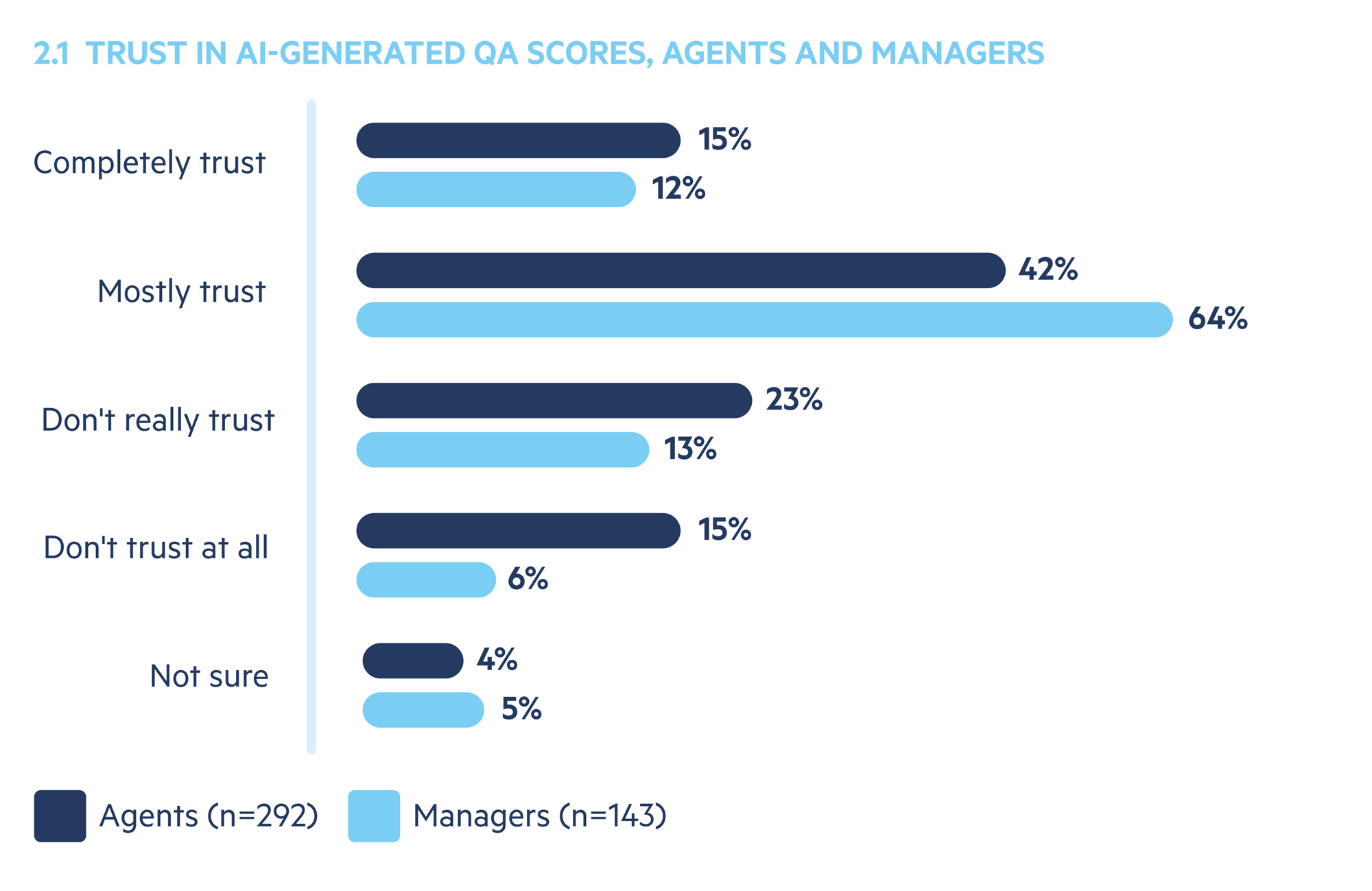
Every quarter, the ScorebuddyCX QA & CX Intelligence Pulse Report surveys contact center professionals on how their teams really work. For the latest edition, the AI Reality Check, we asked 600 of them in the UK and US how much they trust AI QA scores to make decisions about agent performance. Among contact center managers, 76% said they do. Among customer service agents, the people those scores are actually about, 57% said the same.
That's a 19-point gap, and AI scoring is now the norm: nine in ten contact centers in the survey use AI to evaluate interactions.
Agents and managers also report roughly the same amount of human checking behind the scores, yet they still disagree on whether to believe them. So more review won't close the gap on its own. Building trust also depends on what the agent gets to see, and what they can do when a score looks wrong.
Those being scored trust AI QA less
Put the same AI-generated score in front of a manager and an agent and it lands differently. For the manager, it's one reading among hundreds, useful for spotting where a team is drifting. For the agent, it's a verdict on their own calls, with their name on it, and it might come up in their next one-on-one.
That difference in position shows up at both ends of the scale. 15% of agents don't trust AI QA scores at all, against just 6% of managers.
And the gap matters more as coverage grows. A tool like AI Auto Scoring can score up to 100% of conversations, so agents are evaluated on a far fuller picture of their work, rather than the handful of calls a QA analyst happened to pick in a given week.
The complete trust scale for agents and managers is in the AI Reality Check report, free to download.
Most trust in AI scoring comes with conditions
Unreserved trust is the minority position. Across all 600 respondents, 16% trust AI-generated QA scores completely, and a further 48% trust them mostly.
Managers are much more likely than agents to sit in that second group.
"Mostly" is a workable position. It's how you'd trust an experienced colleague: you trust, and act on, their judgment but understand that we all make mistakes sometimes. The problems start when your QA program treats "mostly" as infallible and don't put measures in place for human review of AI scores, which is one of the common reasons why AI QA fails.
More checking won't close the gap
Human review matters, so the obvious fix for low trust looks like more of it. Have your QA team look over more of the AI's work, the thinking goes, and agents will come around to trusting automated scoring.
The survey points the other way. Among the contact centers using AI evaluation, agents and managers describe much the same amount of human review behind the scores. They still reach different conclusions about what comes out of it.
Think about where that review usually happens. A QA lead double-checking scores in a calibration session is out of sight from the floor. The agent sees the number arrive, maybe with a comment attached, but they often have no idea what kind of checks went on behind the scenes.
The review still does its job, which is keeping the scores accurate. It just doesn't build agent trust on its own.
What agents want from a score
Agents don't need to understand the ins and outs of every AI model. But if that model contributes to decisions about their performance, they need confidence that the process is fair.
So the job with AI scoring is the one QA has always had: making a score feel fair to the person receiving it. We've written before about making customer satisfaction surveys fair for agents, and the same test carries over. Can the agent see how the number was reached, and is there somewhere to go when it looks wrong?
AI earns more trust on processes than on people
Trust holds up better when the AI is describing the operation instead of a person. 68% of respondents trust AI-generated insights about processes and products.
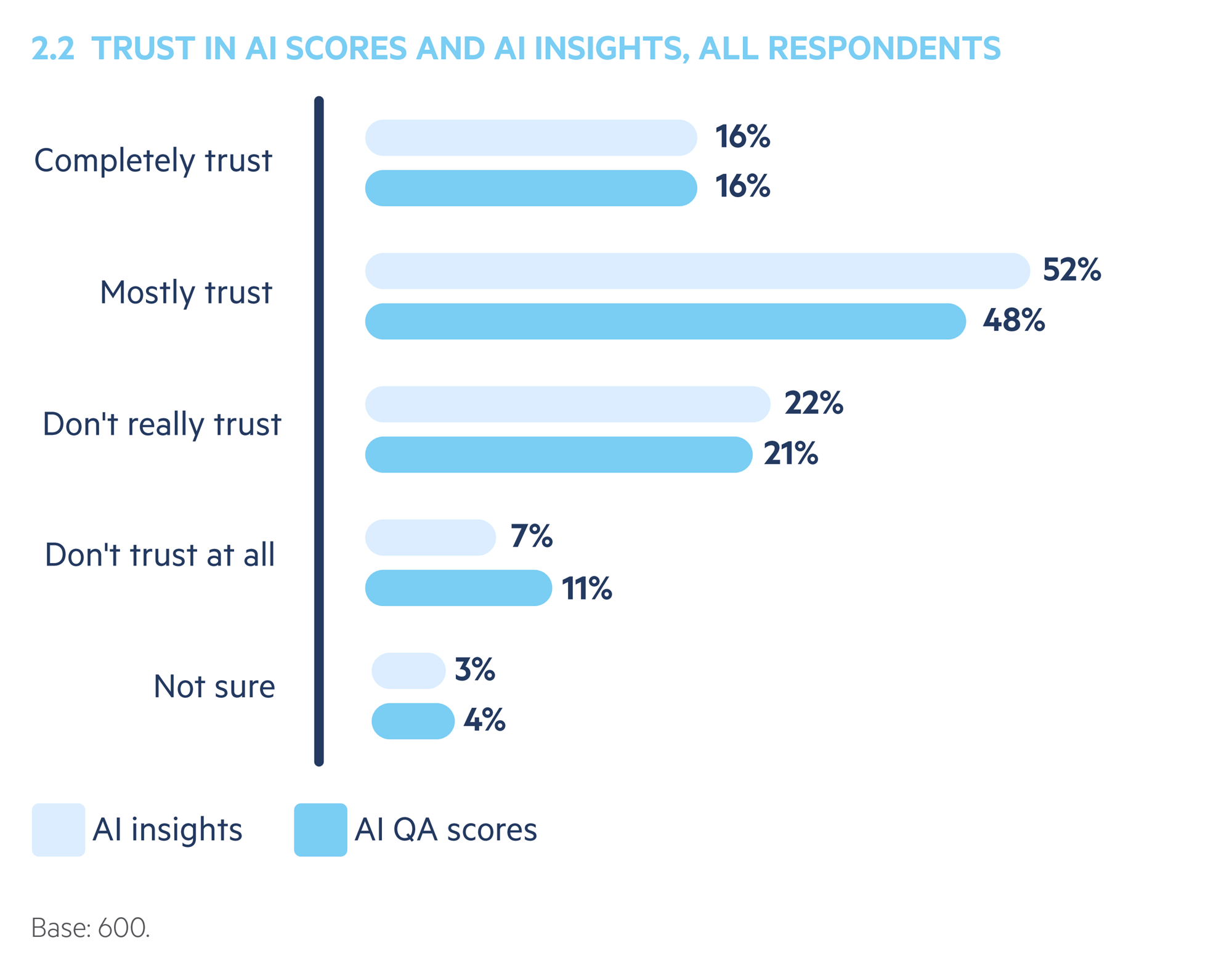
That gives you an easier way in. A coaching conversation that opens on a pattern (repeat contacts about billing are up across the team, and here's what's driving them) starts on ground people already accept. The individual score can come second, as evidence of where the agent sits in that pattern.
How to build agent trust in AI QA scores
- Show the score and what drove it. A bare number asks for faith. Put it next to the scorecard questions and evaluator comments behind it and you're asking the agent to check it instead, which is far easier to agree to. Our QA solution gives every agent a dashboard with their scores, trends, and evaluator feedback, plus a clear process to request a review.
- Make questioning a score routine. Give every agent a defined route to challenge a score, alongside clear visibility into how they are performing, and track what comes back. If agents keep flagging the same scorecard question, you've found something to fix. If nobody ever disputes anything, check that people know the route exists before you read the silence as agreement.
- Let agents score themselves. Have agents self-score a sample of their own interactions against the same scorecard the AI uses, then compare. Where the two disagree, you've got the start of a coaching conversation both sides have already thought about. There's more on why agents should self-score.
- Start coaching from the pattern. Open with what the insight says about the team or the process. Then bring in the agent's own score and the calls behind it, so it becomes coaching grounded in real interactions, with the evidence in front of you both.
- Ask your own floor. Our survey question was: how much, if at all, do you trust AI-generated QA scores to make decisions about agent performance? Try putting it to your own agents and your managers separately and see how far apart the answers come back.
Agent trust decides whether AI scoring works
With AI evaluation now standard across the industry, managers are largely convinced. The agents are the ones still making up their minds, and they're the ones whose calls the scores are meant to improve. A score an agent doesn't believe won't change how they handle the next customer, however accurate it is. So their trust is the one your AI QA program actually runs on.
Trust is only one part of the story. Our AI Reality Check also looks at how often AI scores get a human review and what happens to AI insight once it's generated. Download the full report to see all the findings.