



How often should a human review AI QA scores? There's no single correct number that applies to every organization. It depends on what the scores are used for, and that's going to differ from one contact center to the next.
Organizations need a defined process or framework for human review of AI evaluations. That means deciding which scores always get a human read before anyone acts on them, and who's responsible for checking the rest.
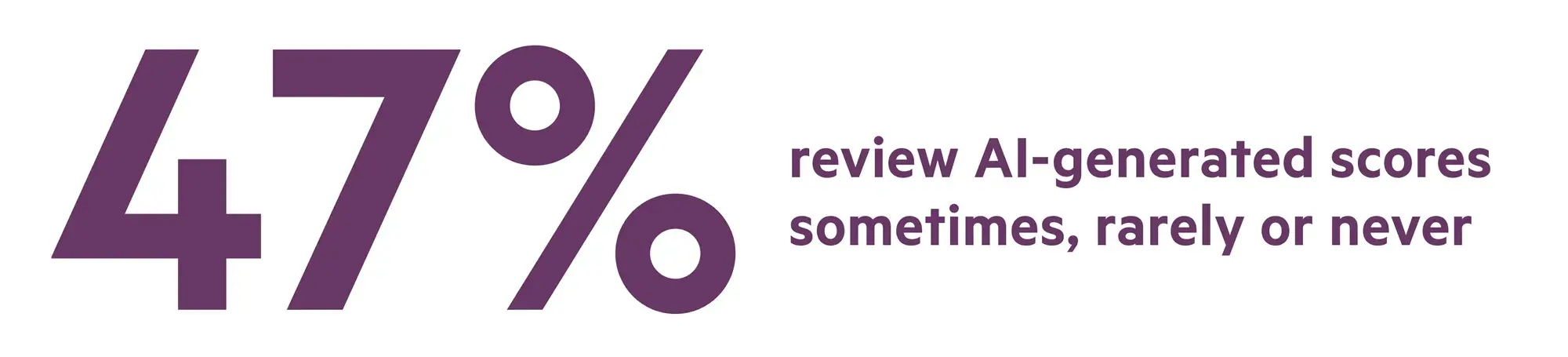
Our latest survey found that in many contact centers, AI scores get a human check only sometimes, rarely or never. That leaves coaching sessions and performance reviews resting on scores no one has looked at.
AI scoring is standard, but routine review isn't
The ScorebuddyCX QA & CX Intelligence Pulse Report runs a fresh survey of contact center professionals every quarter to track how their teams actually work. Its latest edition, the AI Reality Check, heard from 600 of them. Nine in ten said their contact center uses AI to evaluate interactions, so we asked the obvious follow-up: how often are those AI-generated scores reviewed or challenged by a human?
Among the contact centers using AI evaluation, 14% said always. For nearly half, review happens only sometimes, rarely or never, and the rest sit in between.
So most of these teams do check. What varies is whether checking is a routine part of someone's job or something that happens when there's time.
Where does your team sit? The report breaks down how often AI scores get a human review, from always to never. Download the AI Reality Check to compare.
Reviewing every AI score isn't the goal
If a person re-checks every score the AI produces, you've rebuilt manual QA with extra steps. AI can score up to 100% of your conversations. No QA team can read that many, and trying to would throw away the coverage that made AI scoring worth adopting.
That doesn't make the AI self-sufficient, though. You can't just plug it in and expect the perfect QA program right away. There's tweaking, work, documentation, training, etc. that needs to support it. Keeping a human in the loop is a big part of that support, and it carries on after rollout, because scorecards get revised and the reasons customers call keep shifting.
Our reading, rather than anything the survey measured: when review isn't a defined part of anyone's week, it's the first thing to go when the queues get long. And an unchecked score doesn't sit harmlessly in a dashboard. It can surface in an agent's one-on-one or count toward their performance review, or hide a scorecard question the AI keeps getting wrong, one of the common reasons AI QA fails in call centers.
Review keeps scores accurate. Whether agents believe them is a separate question, and one we looked at in our post on whether agents trust AI QA scores.
Can you stand behind the scores?
Try this on your own program. An agent disputes a score, or someone asks what an agent's performance review was based on. Can you say whether a person looked at that score, who it was, and what they checked? If the honest answer is "depends who was around that week," checking is happening, but it wouldn't hold up if anyone pushed.
Regulation is heading the same way. Under the EU AI Act, AI systems used to "monitor and evaluate the performance and behaviour" of people at work are listed as high-risk, and from December 2027, organizations using high-risk systems must assign human oversight to people with the competence, training, and authority to carry it out. An AI QA program can fall into that category, depending on how its scores are used.
The Act also reaches organizations outside the EU, including in the US, when the AI's output is used there. And US states are moving too. Colorado's rewritten AI law and California's new rules on automated decision-making both apply from January 2027. Both cover automated decisions about people's jobs, and both give weight to meaningful human review.
If your operation already answers to a regulator, the principle will be familiar from contact center compliance and risk work: when a decision is questioned, you need to show how it was reached.
How to set up human review of AI QA scores
A defined review process can be short. Four decisions cover most of it.
- Decide which scores always get a human read before anyone acts on them. The right list depends on your business goals, the regulations you work under, how your teams are structured, and where your people are based, so no two contact centers' lists will look quite the same. Scores that count toward an agent's performance review are the usual starting point, and compliance fails tend to belong on the list too, along with any score an agent has disputed.
- Give the rest an owner and a rhythm. For scores that don't need to be read every time, sample on a schedule and name the person responsible for it. A fixed weekly check tied to a specific QA lead's name will probably survive a busy month. A more freewheeling "whenever someone gets a chance" approach more than likely won't.
- Calibrate the AI against your best evaluators. Run the same batch of conversations past your most experienced evaluators and the AI, line the scores up question by question, and rewrite or clarify the questions where they part ways. Even at the 90%+ accuracy AI Auto Scoring delivers, some scores will be off, and calibration shows you where. ScorebuddyCX also lets you flag conversations for a human to review and check the AI's scoring decisions, with a full audit trail behind every scored interaction.
- Let agents challenge scores, and log every review. Give agents a clear process to request a review when a score looks wrong, then record what was checked and what changed as a result. After a few months, the log shows you which scorecard questions keep getting corrected, and whether your review time is going where the errors actually are. And when someone asks you to stand behind a score, it's your answer.
Why human review matters
It would be a mistake to treat human review as a stopgap on the road to completely automating your QA. It's much more than just an early-stages calibration exercise to get the AI up to speed.
In fact, we'd argue it's what makes the scores usable at all.
Scores feed coaching, where they can change how an agent handles their next customer, and the business insights derived from QA results can inform teams well beyond the contact center. That's a lot riding on a score nobody has checked.
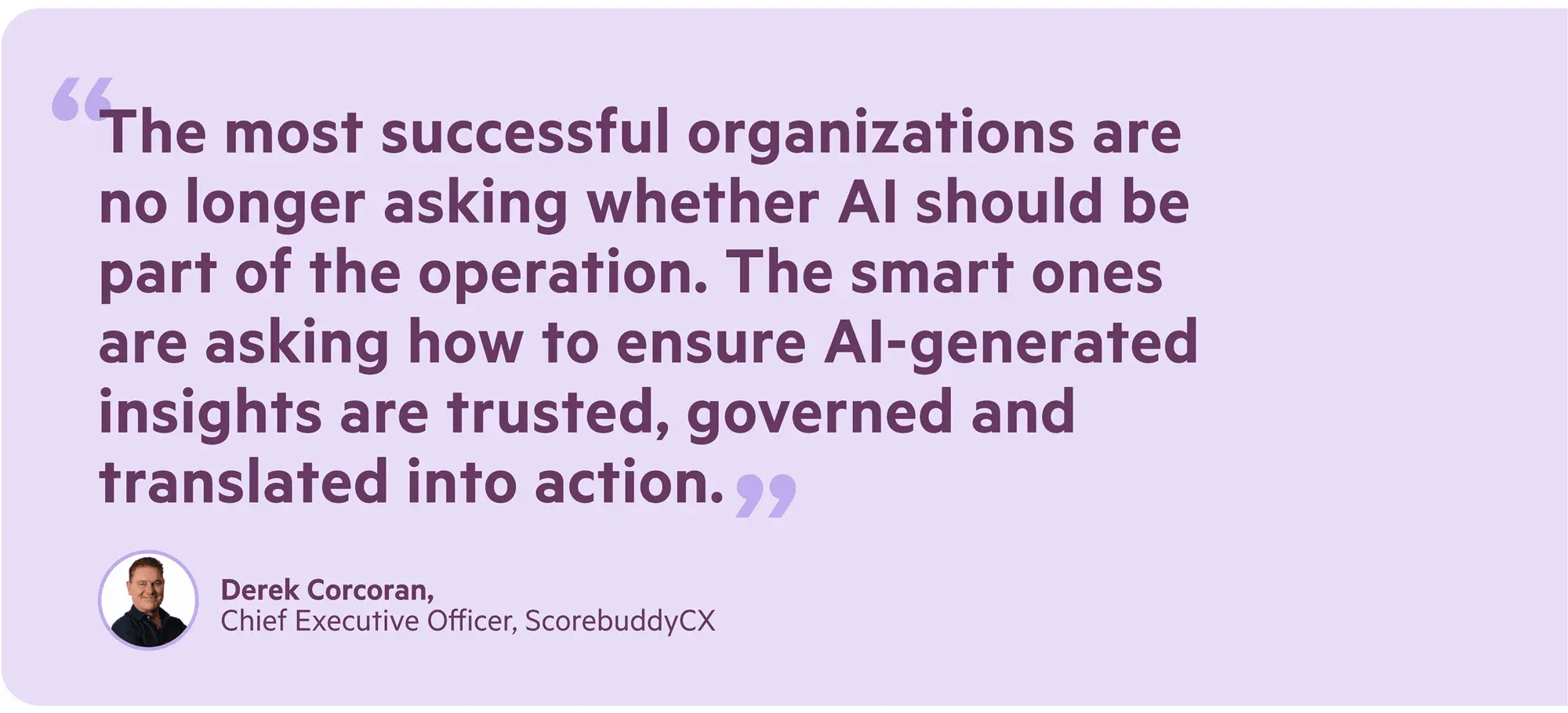
How often scores get reviewed is one part of our AI Reality Check. The report also covers how trust in AI scoring splits between managers and agents, and how much AI insight makes it into coaching. Get the full report to see the rest of the findings.