






At our CX Excellence Masterclass, we walked through a six-week pattern. One topic (customers being put on hold) doubled in volume in week two. The average QA score stayed flat the whole time, because every agent handled every call correctly, if you were going purely by the scorecard criteria. And then CSAT dropped in week four.
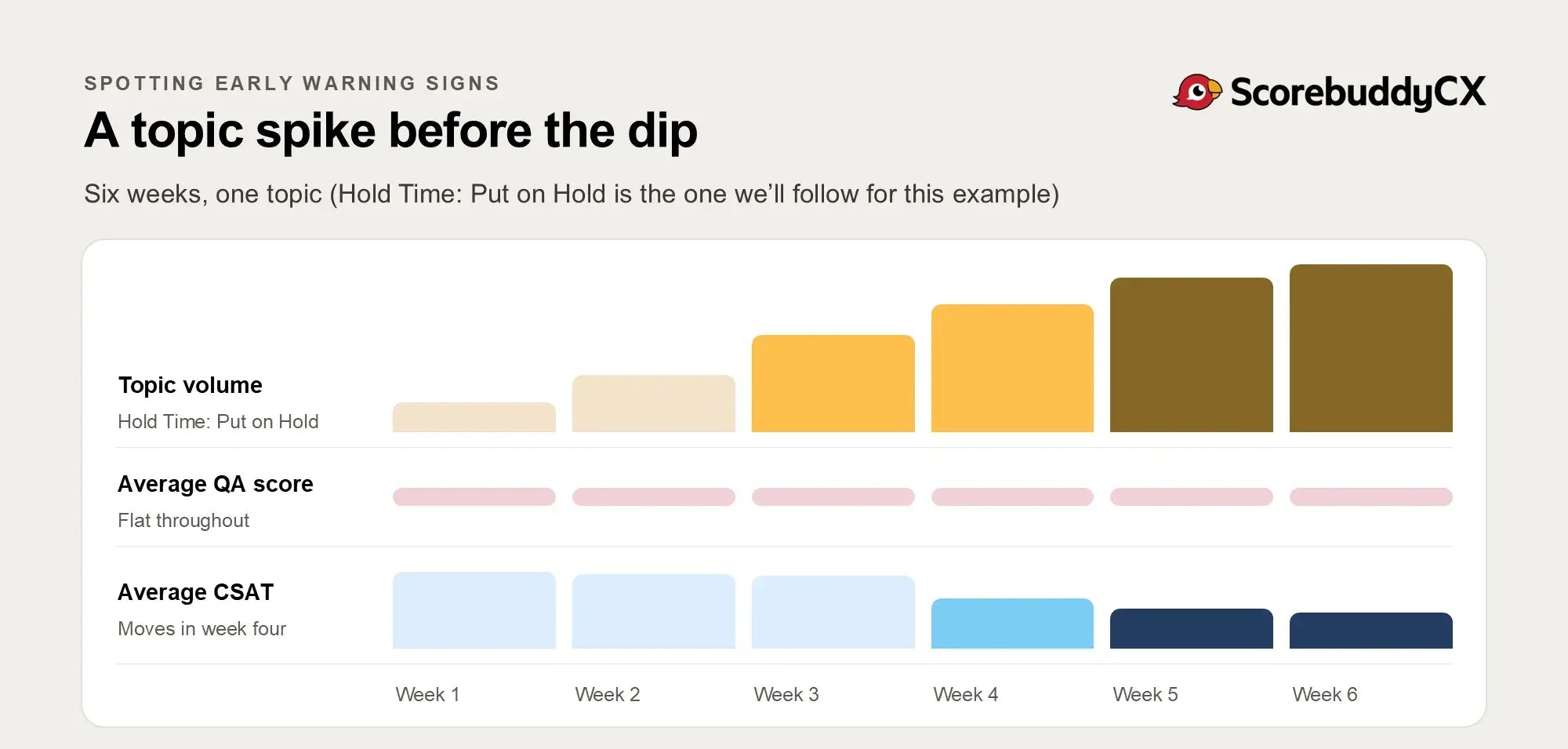
As Aaron Mulville, who led the masterclass, put it: "The pattern only exists in aggregate, and it was visible weeks before the CSAT confirmed it."
So that's a two-week window where the early warning signs were already coming in. Every team has a window like that, but not every team is set up to take advantage of it.
To spot a CSAT drop before it shows up, there are four signals to watch in your conversations every week: a topic climbing in volume, one topic splitting by team, repeat contacts on a single issue, and conversations that pass QA but fail the customer's view. Then you calculate your own window from last quarter's data, so you know how far in advance of the survey results these signals are flagging a potential CSAT dip.
Why CSAT is always late
A satisfaction survey can only report on a conversation after it's over. In the single-call example from the masterclass, the survey came back about an hour after the call, and by the time anyone read it, it could be a week later. That's before the responses get rolled up into a report.
Then there's who answers. CSAT responses generally cover 5% to 10% of contacts, so the survey only gives you the outcome for a small group, and rarely the cause behind the score.
We're not saying this makes CSAT less important. After all, it's the only place customers speak in their own words, and it's the outcome everything else should be measured against. But it shouldn't be (and isn't) your first warning.
Three ways to see a CSAT drop sooner
Each of these approaches will shorten the gap between something going wrong and you knowing about it.
1. Coverage: patterns a small sample can't hold
Manual QA generally reviews 2% to 5% of conversations. That's enough to coach individuals. But it's too thin to show a hold-time spike every Tuesday behind one product issue, or a knowledge base article that keeps leading to wrong answers.
If you automate your QA scoring on up to 100% of conversations, you can catch those patterns in the cycle they start. A sample might not catch them until the next audit, if ever.
People should stay on the judgment calls, of course, with regulated, high-risk and disputed cases still going to a human reviewer.
2. Topic detection: an issue cluster forming
Topics tell you why customers are getting in touch: a billing issue, say, or a new product release. With conversation analytics, track them week to week and you'll see a cluster forming, like billing overcharges climbing before anyone formally reports them. Phrases such as "cancel my account" can also raise their own alert. By our estimate in the masterclass, a dangerous topic spike shows up weeks before CSAT confirms the issue exists.
3. Driver analysis: why the score is moving
Driver analysis tells you which topics and interaction attributes are statistically linked to outcomes like CSAT, NPS and retention. Finding your drivers does take survey data. The method from the session, multiple regression, compares your scorecard results with your CSAT results to see which questions pull hardest on the customer outcome.
In the example we ran through, empathy and hold time pulled hardest, first-contact resolution and accuracy much less, and script adherence barely registered.
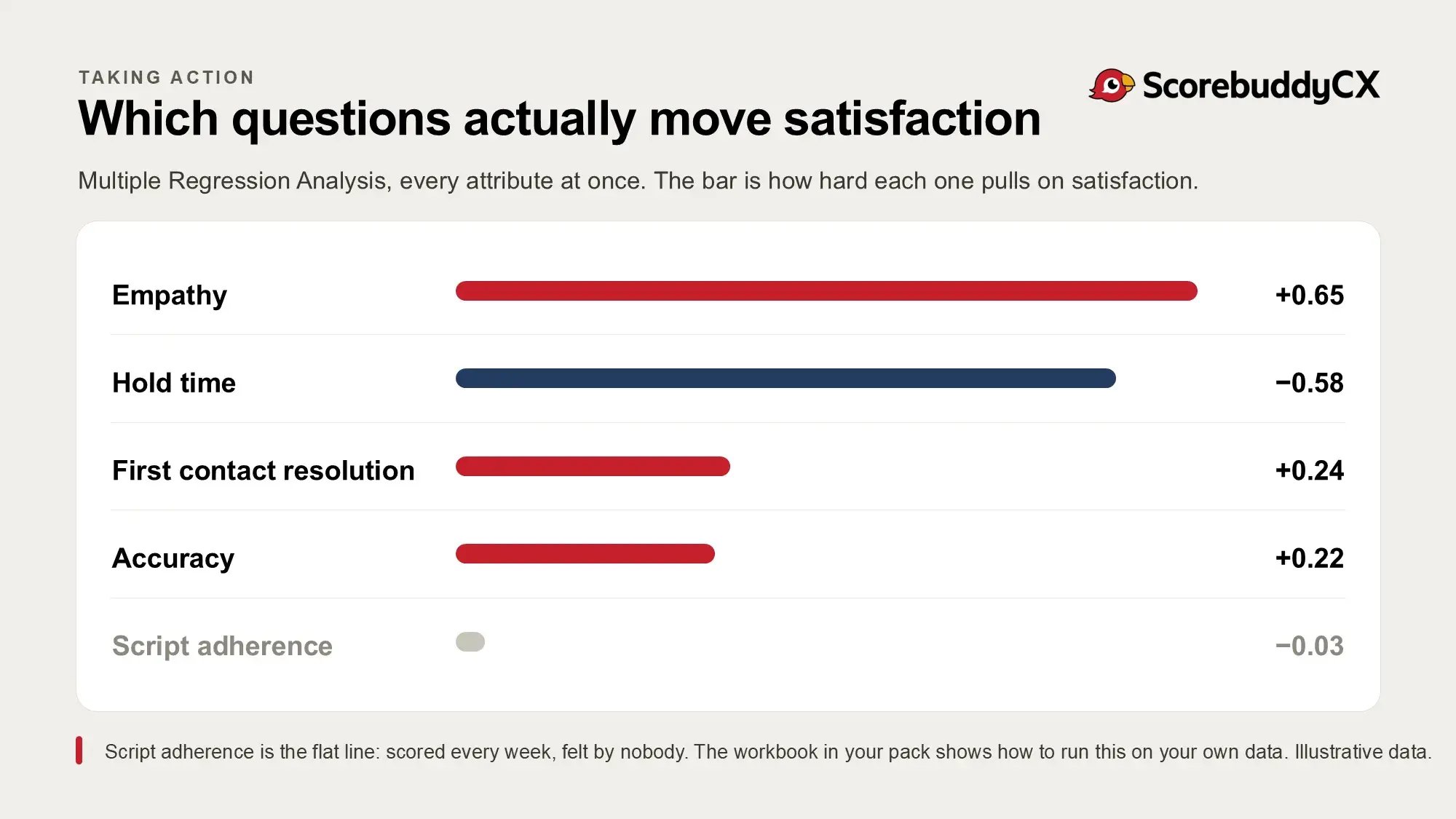
Once you know your drivers, you don't have to wait for the next batch of surveys. You watch those attributes on every scored conversation, and a move in one of them tells you where CSAT is likely heading.
Want to find your own drivers? The masterclass comes with a regression workbook that runs on your own scorecard and survey results. Get the workbook and recording.
The 15-minute weekly check
Start with the views you already have: the same few each week, and assign a named owner for each signal.
#1. One topic climbing in volume. Act when it's rising over two consecutive weeks, or sits a quarter above its four-week average. Look for the cause before you look at the agents, so this one probably belongs to the process or product lead. It gives you two to three weeks' notice.
#2. The same topic, splitting by team. If one team sits clearly below the topic average on the customer side of the scorecard, coach the questions that split, because coaching on the whole scorecard would be inefficient. The team lead owns it, and it shows up about one cycle early.
#3. Repeat contacts on one issue. Same customer, same topic, inside a week, above your normal repeat rate. Something in the process is forcing the callback, so it's your ops owner's to fix. Expect it a few days ahead.
#4. A low customer section on a passing QA score. Act on any conversation that passes QA but fails the customer's view. Read it, then decide whether it needs coaching or a callback. This is the same-day signal, and the team lead takes it. It needs a scorecard that keeps the customer's side as its own zero-weighted section, the setup the first article in this series explains.
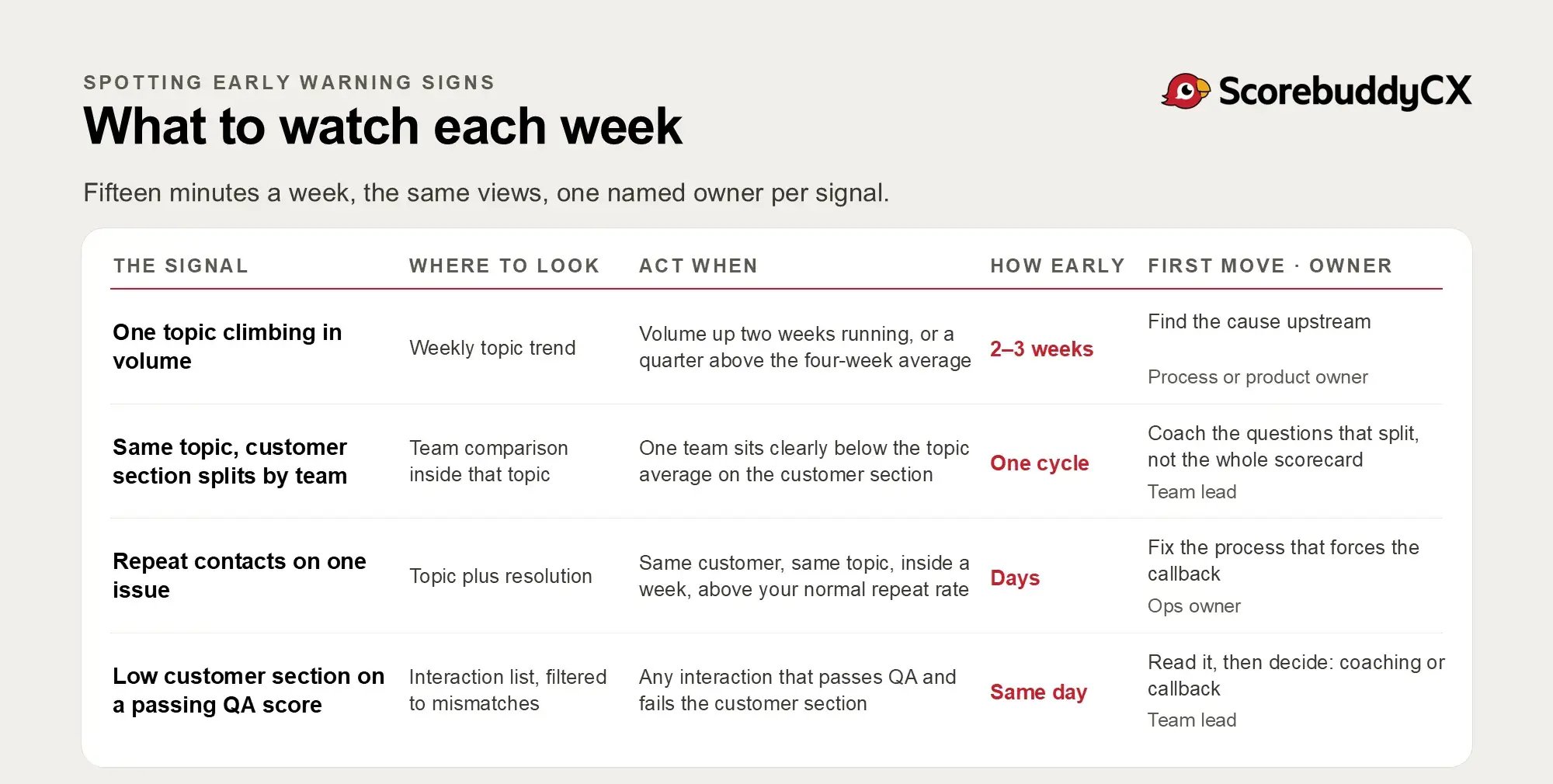
The thresholds we've mentioned here are just general starting points. It would be useful to spend the first month setting yours from your own baseline, and then holding them after that.
Work out your own early-warning window
You can do this with last quarter's data:
- Pick your three biggest topic spikes.
- For each one, note the week volume climbed and the week CSAT moved.
- Count the weeks between them.
That count is your early-warning window, taken from your real-world data. Set the weekly check to look that far ahead. When a topic climbs, you'll know roughly when CSAT will feel it, and how long you've got to fix the cause.
What to do next
- Start with a topic you know is noisy. The method is easier to prove on a problem everyone already recognizes.
- Name one owner per signal before the first weekly check, so findings land with someone who can act on them.
- Get your CSAT owner's weekly figures before you count the window. The calculation runs on their data, so they should see the result before anyone else does.
- Fix coverage first if you only score a small sample. The signals need enough scored conversations to show a pattern.
Get the full method for catching CSAT dips early
By the time a CSAT drop reaches the report, it's old news. The conversations behind it said so weeks earlier, to whoever was scoring them.
Want to set up the hybrid scorecard behind the fourth signal? The CX Excellence Masterclass recording walks you through it, and you'll also get:
- The post-session pack, with a ten-question scorecard example and a 30-day plan for getting your first numbers
- The regression workbook, for finding which of your QA questions actually move customer satisfaction scores
