




Your company records thousands of customer conversations a month. It probably reviews a handful. Conversation intelligence is the software that closes that gap: it captures and transcribes those conversations, then analyzes them at scale to surface insight you can act on.
Search "what is conversation intelligence" and you get two very different answers. Sales tools will tell you it's for coaching reps and forecasting deals. Contact center tools will tell you it's for scoring agents. Both are right, and both are narrow. The bigger story is that the conversations you already record are the clearest customer intelligence you own, and most of it never leaves the contact center. That is what needs to change.
What is conversation intelligence?
Conversation intelligence is a category of software that analyzes customer interactions, across voice, chat, and email, to surface what is actually happening inside them. It transcribes the conversation, then uses natural language processing and machine learning to pick out customer sentiment, recurring topics, the reasons people got in touch, and the moments where something went wrong.
The reason it exists is simple. Manual review can only ever cover a sample. If your QA team listens to two or three calls per agent each month, the other several thousand go unheard, and any pattern living in them stays invisible.
This is no longer a fringe idea. In ScorebuddyCX's Quarterly QA & CX Intelligence Pulse, 56% of organizations said they rely on AI for most evaluations or as a core part of QA. For a closer look at how contact centers put it to work day to day, we covered conversation intelligence software separately.
Conversation intelligence vs. the terms it gets confused with
The term gets tangled up with a few neighbors. Worth pulling them apart.
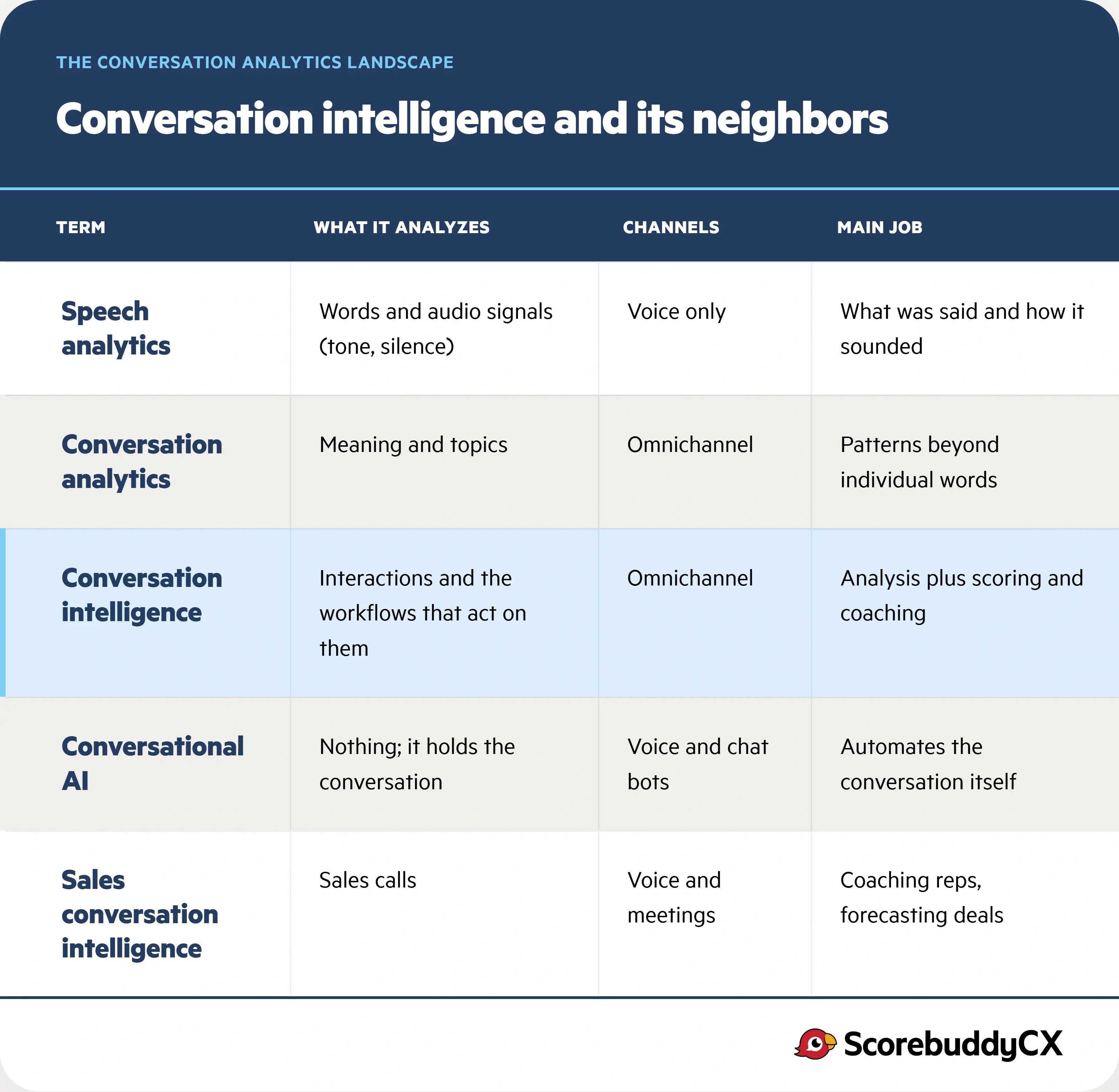
Speech analytics looks at voice calls. It transcribes them and flags keywords, phrases, and audio signals like tone or long silences. Useful, but voice-only, and mostly focused on what was said and how it sounded. We went deep on speech analytics elsewhere if you want the detail.
Conversation analytics is broader. It works across channels and digs into meaning and topics, going beyond individual words. People use "conversation analytics" and "conversation intelligence" more or less interchangeably, and so do most vendors: ScorebuddyCX surfaces this capability under Conversation Analytics. The label matters far less than what the tool does with what it finds, which is where the real differences show up.
Conversational AI is a different animal. That is the chatbots and voice assistants that hold the conversation with the customer. Conversation intelligence analyzes conversations. Conversational AI is the thing having them. Easy to mix up, because the words are nearly identical.
Sales conversation intelligence is the version most of the search results are selling. Tools like Gong point the same underlying technology at sales calls, a category often called revenue intelligence, to coach reps and forecast deals. That's a real use, and a valuable one. It just answers a different question than the one a customer service or customer experience (CX) team is asking.
That is what separates a real conversation intelligence platform from a glorified transcription service: what happens after the analysis.
How conversation intelligence works
Under the hood, the process is fairly consistent from tool to tool.
It captures interactions wherever they happen, across voice, chat, and email, then pulls them into one place. It transcribes anything spoken, turning voice into text with speech recognition. Then the analysis runs: natural language processing tags sentiment, picks out topics and contact drivers, spots missed steps or compliance red flags, and scores the interaction against whatever criteria you have set. The better platforms run that same analysis on AI agents and chatbots, which matters more every quarter.
The headline capability is coverage. Where a person can review a sample, the software reviews everything. Coverage is where manual review hits a wall: 74% of contact centers told our Pulse research they had increased QA coverage in the last three months, and no amount of manual listening keeps pace. ScorebuddyCX customer Intercom, for instance, can automatically evaluate up to 100% of its interactions with AI Auto Scoring, where before it was sampling a fraction.
Coverage on its own, though, is just a bigger pile of data. What you do with it is the next question.
Beyond the contact center: who conversation intelligence is really for
This is usually where the definition ends, with conversation intelligence filed away as a contact center tool. But the insight it produces is useful to plenty of people who never set foot on the contact center floor.
Think about what is actually in those conversations. Customers telling you, in their own words, why they called, what confused them, what nearly made them leave, which feature they could not find. All of that is product research, marketing copy, an early-warning system, and a record of where your operation breaks.
So the audience is wider than it looks:
-
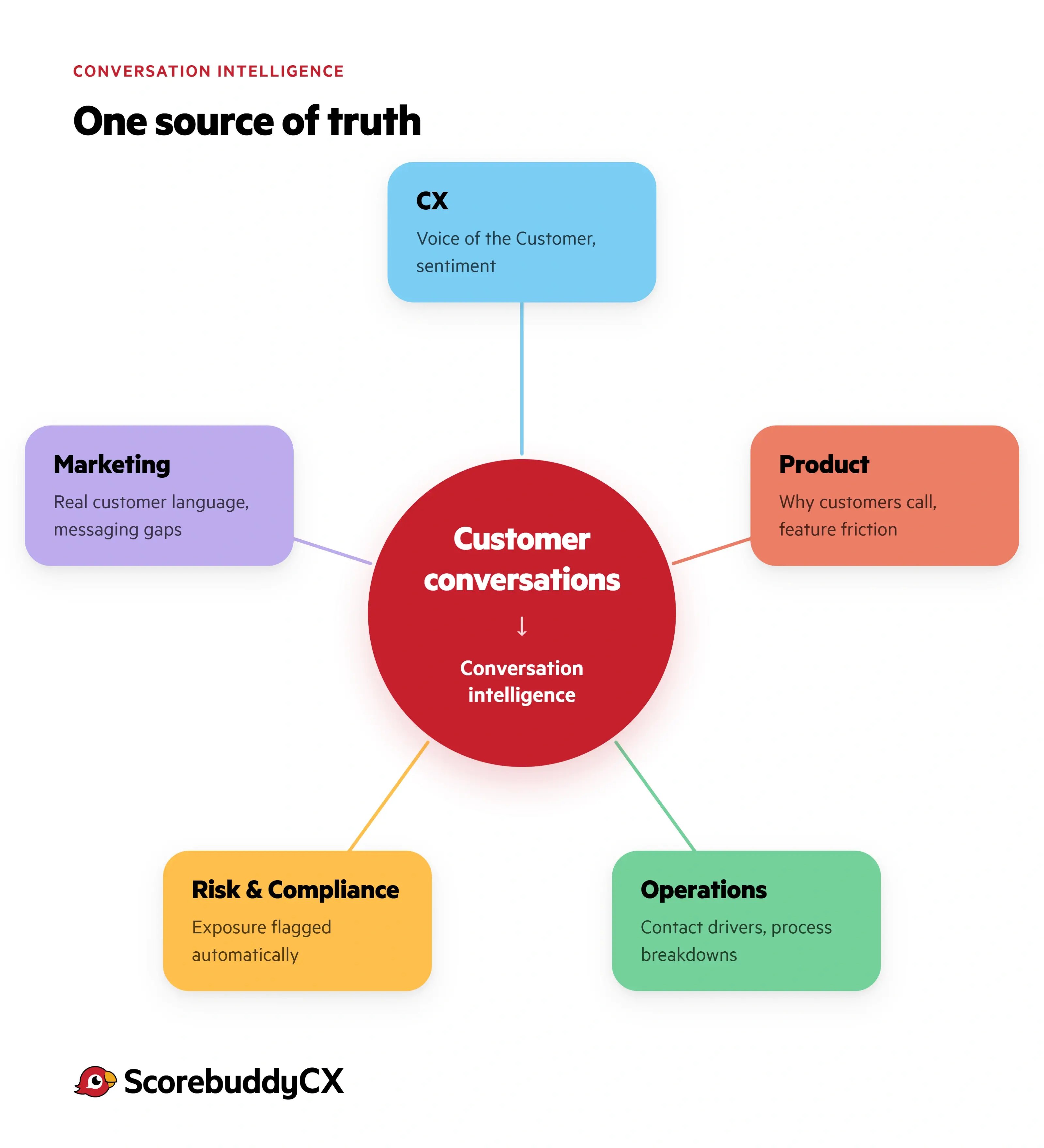
CX leaders get Voice of the Customer and sentiment trends grounded in every interaction rather than a survey sample.
-
Product teams learn why customers really get in touch and where features create friction, straight from the source.
-
Marketing hears the actual language customers use, and the gaps between the promise and the experience.
-
Operations sees the contact drivers and the process breakdowns sitting behind them.
-
Risk and compliance get exposure flagged automatically, instead of hoping a sampled call happens to surface it.
Sales conversation intelligence coaches reps on deals. Contact center tools score agents. Whole-business CX intelligence does something bigger: it lets the entire organization learn from what customers are actually saying, wherever the useful part happens to land.
You can review every conversation and find out, very fast, the things that are and aren't working. You can look at it really high level, whole categories of complaint stacking up in one product area, or you can get granular and see that one team keeps fumbling the same part of the onboarding call. Then you go and fix it. There's a bit more setup involved than that makes it sound, but with the right platform you can dig into conversation data in a way that would have been unimaginable a few years ago. Surfacing that signal for every team is exactly what conversation analytics is built to do.
This is what ScorebuddyCX customer Permanent TSB was getting at, describing the "genuinely insightful data which we use to improve performance across multiple areas of the business." Multiple areas of the business, not just the contact center.
What to look for in a conversation intelligence platform
If you are weighing conversation intelligence software, the feature lists all start to look the same. A few things genuinely separate the useful platforms from the expensive dashboards.
First, and most important, is the action layer. Plenty of tools will show you sentiment charts and topic clouds. Far fewer connect that insight to anything. Box-ticking QA is ultimately fruitless, and QA for QA's sake goes nowhere. The same is true of conversation data: gathering it is easy, and learning from it is the part that changes results. Look for a platform where insight feeds coaching, training, and decisions, rather than one that just reports.
There is evidence teams feel this gap. In our Pulse research, 88% of leaders said they feel confident in their performance data, but only 42% said they were very confident. The information is there. The certainty about what to do with it is not. And with 85% of professionals naming coaching as the most effective driver of performance improvement, the platforms worth paying for are the ones that shorten the distance from insight to action.
The rest of the checklist is more straightforward:
-
Full coverage, so you are analyzing every interaction rather than a sample.
-
Support for voice, chat, and email in one place, since customers don't stick to one channel.
-
Analysis that covers AI agents and chatbots as well as human ones.
-
Reporting other teams can actually use. Business intelligence that surfaces insight to product, CX, and ops is what turns it from a QA artifact into a whole-business asset.
How ScorebuddyCX approaches conversation intelligence
This is what CX intelligence means at ScorebuddyCX: the platform is built around that action layer. It scores conversations, analyzes them, feeds the findings into coaching, and closes the loop with integrated learning, so the insight actually goes somewhere. Coverage can reach 100% of customer interactions across channels, human and AI agents alike, and the analysis is designed to travel beyond the QA team, to CX, product, marketing, and operations.
None of that removes the need for people. AI can give you more data and more capability than you've ever had, but people are still the key, on the floor and in the decisions that matter. The platform's job is to make sure the signal in your conversations reaches the people who can act on it, faster than a sampled review ever could.
That is the real promise of conversation intelligence: the conversations you are already having, finally working for the whole business. If you want to see what that looks like on your own calls, book a demo.