





I set up the first contact centre for a shirt brand, back in the early 1990s. It was outsourced to the company I worked for, we chatted to customers about collar sizes and sleeve lengths. Even then we used our data to find the real reason behind a call and fix any issues at the source. Contact centres were initially built to look after people, and plenty of them were vulnerable customers, but we didn't use the term back then, everyone was an important customer.
Somewhere along the way, contact centres became the place where organisational failures finally meet the customer. And when a vulnerable customer suffers because of those failures, we still reach for the same solution, retrain the agent, coach the team and revisit the policy, instead of fixing the system that caused the problem.
I understand people's instinct. The agent is the person seen on the frontline, the last voice in the conversation, but by the time a vulnerable customer reaches that agent, most of what will decide the outcome has already happened somewhere else in the business. So coaching helps, however it will never be enough on its own.
Mistaking activity for impact
Walk into most organisations and ask how they support vulnerable customers, and you'll get a tour of the evidence. The policy, the training records, the QA scorecards, the vulnerability flags sitting in the system.
All of it is real, and most of it is well meant. But it answers a different question than the one that matters.
How do you know any of it is actually working?
Not whether the training was delivered, nor whether the box was ticked or the right words were used, and definitely not whether the person on the other end was really better off for having spoken to you.
The biggest failures here don't happen because people don't care, they happen because organisations mistake evidence of activity for evidence of impact. A full training calendar feels like progress, but it tells you almost nothing about whether a frightened customer got what they needed at four o'clock on a Thursday.
The agent is the last link in the chain
Think about where a vulnerable customer's experience is really shaped.
It rarely starts with the call, it normally starts with a letter that creates confusion, then a journey that falls apart between departments. A policy written far from the reality of the customer, and a form that asks the wrong questions. By the time someone, especially someone vulnerable, reaches an agent, the outcome has already been shaped. Yet we still hand the agent a headset, a target and a script, expecting them to fix problems they never created.
You can coach empathy all day, however you cannot coach someone past a system that was built to stop them helping.
My fellow panellist Elaine Lee shared an example of a contact centre running at 240% staff attrition. When it gets that bad, the problem is not just hiring. We know it is the role, the work has drastically changed underneath people. The emotional load has increased, the judgement required has increased, but the job description, recruitment and support has not kept pace. This is how organisations are setting people up to fail, and then their answer to that, send them on a course, that will fix it.
None of this means coaching doesn't matter, because it absolutely does. Coaching, when it's done well, and built around real conversations rather than rigid scorecards, is some of the most valuable work a contact centre can do.
The problem is that we've asked coaching to carry a weight it was never designed to carry. Much of what reaches an agent is failure demand created elsewhere in the organisation. Coaching can help people deal with that more effectively, but it can't remove the cause.
You don't coach your way out of organisational failure, you design your way out of it.
Vulnerability doesn't respect your org chart
We get this part so wrong.
A business runs on journeys, work journeys, (workforce, workplace and workflow) and a customer's journey doesn't care about your org chart. It crosses department after department, and the vulnerability shows up at the frontline because that is where the customer finally reaches a person. The issues, the root causes, and the fixes, are almost always somewhere else.
This is where I think we've got it wrong. We have to stop looking at departments as separate parts of the organisation and start looking at how they work together, because that is where the real customer journey is created.
It is not just recruitment, it is all of HR, it's Compliance, Quality, IT, Finance, it is all departments. It's the teams writing the letters, designing the processes, building the systems and creating the policies. Every one of them shapes the experience long before a customer ever reaches the contact centre.
That is why they all have to move together, not as individual functions, but as one organisation, orchestrated around the same purpose.
Imagine what that would mean for the frontline, instead of spending so much of their time apologising for what has already gone wrong, they would be free to do what they came into the role to do in the first place.
Which is 'to help people'.
Every department is a support function, with everyone in the business contributing to how a vulnerable customer is treated, whether they ever speak to one or not.
That's not how most organisations run it. Ask me whether contact centres are doing enough to prepare for the reality of vulnerable customers, and my honest answer is no. Even the big ones, the ones doing plenty, aren't where they should be. Too many still treat vulnerability as a separate thing, off to the side. If we have time to do this, then we'll do it. When it should be an intrinsic part of the customer experience, running through everything.
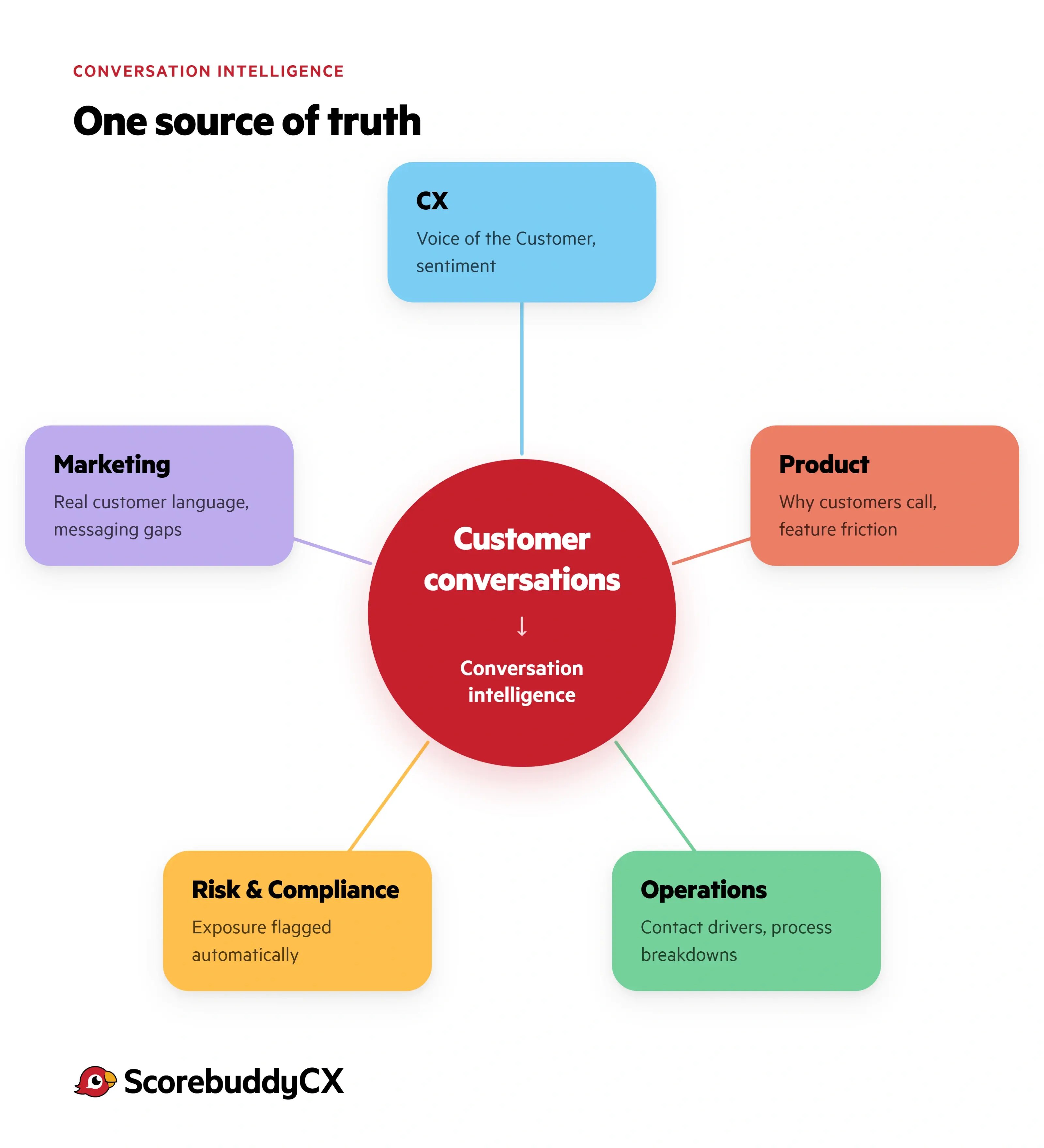
The signal is already there, in your conversations. The trouble is it stays trapped in the contact centre, when the people who could fix the root cause are sitting in another department altogether. Getting it to them is where the right tools earn their keep: something that can surface those signals from every conversation rather than a lucky handful, then put them in front of the people who can act and support.
Where the effort should go
So, if not another training course, then what. A few things I'd start with.
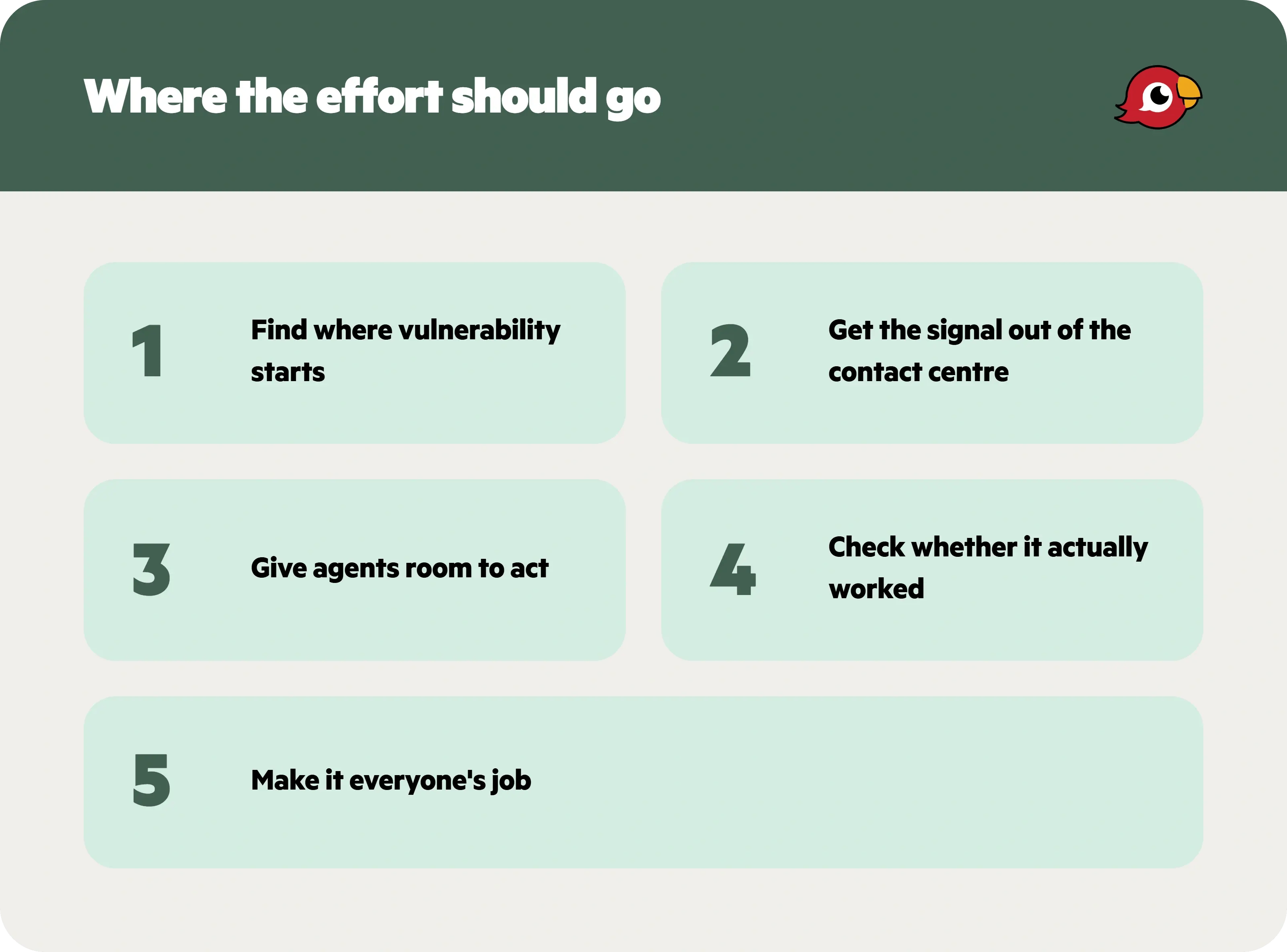
Find where vulnerability starts. Map where it originates across the business, because the frontline is only where it surfaces. Follow a hard conversation back and you'll usually find a broken handoff, a decision taken three departments away, a process nobody owns end to end.
Get the signal out of the contact centre. The insight your agents generate every day is wasted if it dies in a QA report. Put it in front of every team that shapes the journey, because they're the ones who can stop the problem happening again.
Give agents room to act. Real authority, the right tools, and the correct education, do far more than another script. If someone has to fight four systems to help a distressed customer, no amount of coaching fixes that. Clear the path first.
Check whether it actually worked. Measure the outcome for the customer: did the problem get solved, or are they ringing back next week with the same thing? There's a companion guide to supporting vulnerable customers on the frontline that goes into the scorecard side of that.
Make it everyone's job. Take an honest look at how mature you really are across departments, not the frontline alone, undertake a maturity assessment. In my experience the gaps are rarely where people expect them to be.
You can coach the last mile. You have to build the road.
Supporting vulnerable customers was never going to come down to how well you train the people who answer the calls. Now, we all know that part really matters, but it is just part of the work that needs to be achieved.
This is a leadership decision. It's about choosing to build an organisation where every department plays its part, where vulnerability is everyone's responsibility, and where the whole business moves together with one purpose.
Get that right, and by the time a customer reaches the frontline, your people can do what they do best.
By all means, coach the conversation.
Just don't expect coaching to fix everything that happened before it.
Coaching helps people succeed. Organisational orchestration helps the whole business succeed.
This piece grew out of a conversation I had with Philip Bourke and Elaine Lee for the ScorebuddyCX webinar, Beyond the Vulnerability Checklist.