





A few weeks ago I rubbed my eyes.
That was the whole mistake. I'd been outside, touched something I shouldn't have, or was it in the kitchen and there were some coffee granules on the top I did not see, that's another story.
Anyway, the outcome was that I rubbed my eyes without thinking. Within 20 minutes I could barely see straight, was so frustrated, and at that moment I thought please no-one call, I don't care what it is, not in the best state to be discussing insurance, utilities, anything.
So, I took an antihistamine and waited it out, and within a couple of hours all was okay.
But if a contact centre had called me that afternoon, I'd have been a vulnerable customer. Even though nothing about me had changed except some time.
That's the bit we keep getting wrong. We talk about vulnerable customers as though they're a set group, people we can spot and flag and tick off a list. Well, they are not. Vulnerability is a state you move into, sometimes in minutes. A diagnosis does it. So does a bad night's sleep before a hard phone call, or a letter that makes no sense, or a bereavement you haven't told anyone about yet.
The person who coped perfectly well last week might not be the same person this week.
So, before we get into how to support vulnerable customers, I would like to widen the question. Because if you honestly think about it, we are all vulnerable at some time. This is just us, being human. And how you build for that says more about your organisation than any policy document ever will.
Who's vulnerable? Most of us, some of the time
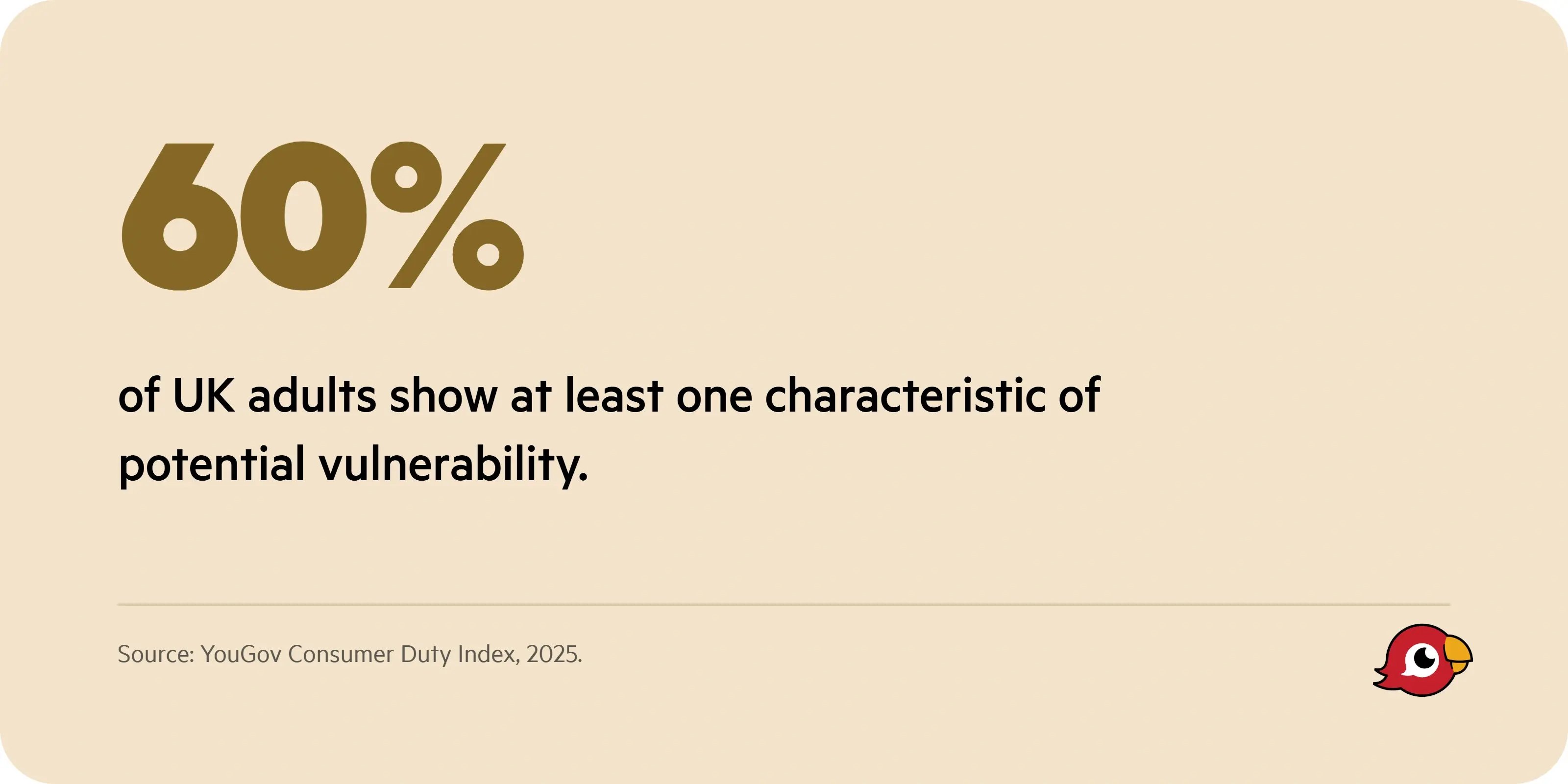
None of this is rare. Somewhere around 60% of us are living with at least one thing that could tip us into vulnerability at any given moment, and plenty of people are juggling two or three at the same time. So the customer who sounds completely fine, is probably managing something you have no idea about, because you cannot hear it, but most people are.
That is the centre of your operation, even though we keep building as though it sat somewhere out at the edges.
We do love to make it a label, though. Something you pin on a small, separate group. So, we write a policy. We add a flag to the system somewhere. And we tell ourselves we've dealt with it. Box ticked.
But people don't ring up and announce it. Nobody opens with "just so you know, I'm grieving today," or "I'm frightened," or "I'm one missed payment from real trouble." So if your whole approach is built around the customers who say it out loud, you will miss the ones who can't, or won't, every single time.
It catches up with all of us eventually. Sit with that one, because the moment you really believe it, the whole problem looks different.
Design CX for vulnerability and you design for everyone
Constant discussion with Elaine Lee and thirty years background in customer operations and transformation keeps bringing me back to the same thing Elaine and I have discussed so many times. Design for the customer at their worst moment and you do not only help that customer, you raise the bar for everyone who comes after them.
The clearer explanation you write for the person who's frightened? It helps the person who's perfectly calm too. The extra few minutes you allow for the hard conversation helps everybody, because sooner or later everybody has the hard conversation.
I worked with a healthcare client once where, honestly, every single caller was vulnerable. Every one. Some were unwell, some in pain, some showed no issue and just wanted their prescription, but you knew the vulnerability was there behind it. Then there were the angry ones and the frightened ones who were ringing on behalf for someone they loved.
There was nowhere to hide behind a script, and definitely no comfort blanket of "most people are fine," as they weren't. But what it did was force a level of care that should be the standard everywhere.
And there's one more group we tend to leave out of in all this. Our frontline people.
The person on the other end is human too. They absorb other people's distress for hours, with a queue stacking up and a clock ticking the whole time. A policy is not protection. A script is not empathy. A QA score is not an outcome.
So if you want people to really care for vulnerable customers, you have to build somewhere that care can actually happen. That is what this is really about. The human experience, on both sides of the conversation.
So what actually needs to change?
This is the part I care about most. It is so easy to nod along to all of this and then change precisely nothing on Monday morning. So let me get specific.
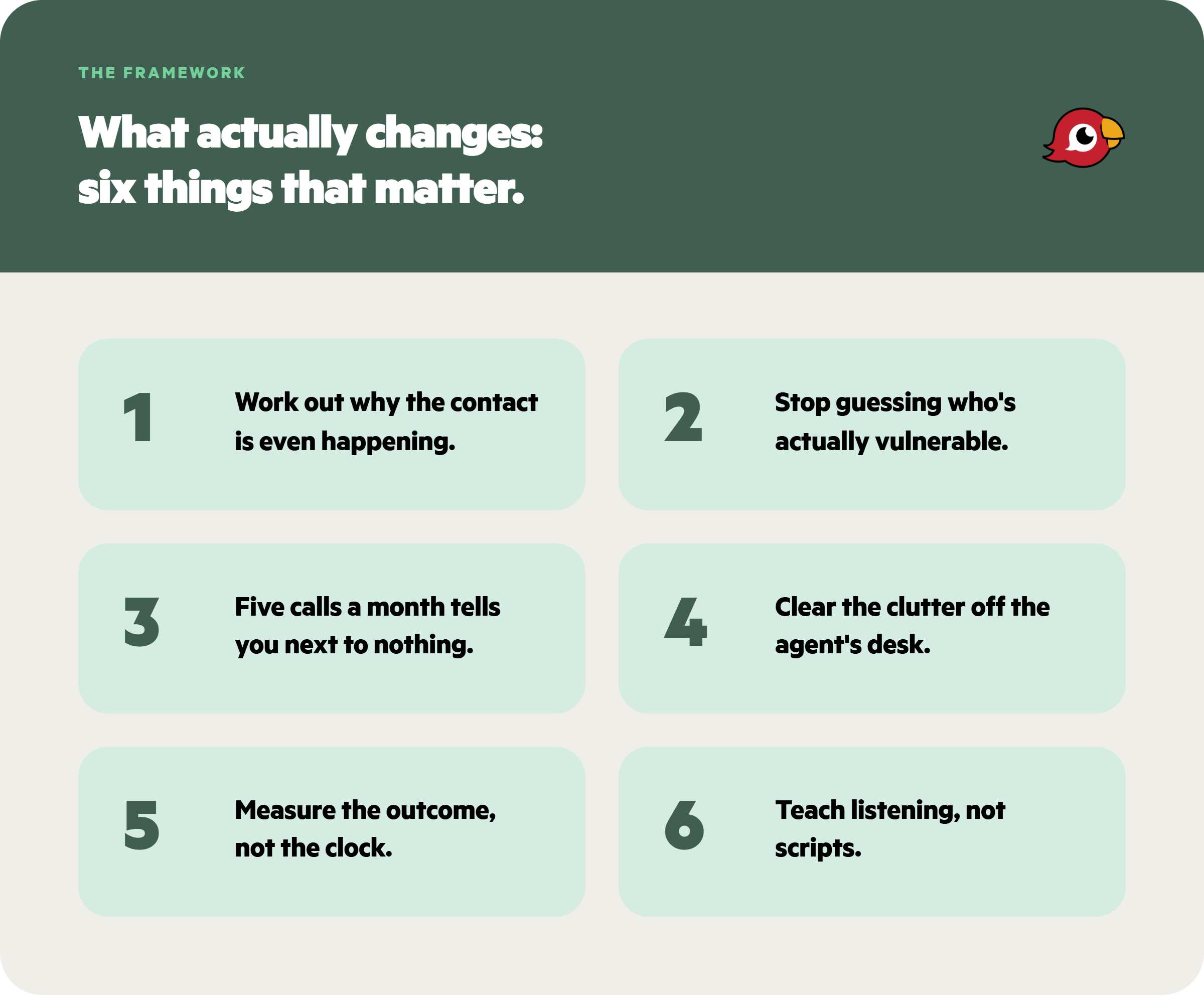
Work out why the contact is even happening. Somewhere along the way, the contact centre turned into the place businesses send their consequences. People get in touch because a letter made no sense. Because one system didn't talk to the next one. Because they got passed around four departments and had to start again each time. That is failure demand, and it eats up the capacity you need for the conversations that actually matter.
I worked with one team where we just kept analysing the data, all of it, and found that a huge share of their calls traced back to a single broken thing upstream. A delivery partner letting people down. They brought the partner in, fixed it, and those calls just vanished. It was not only a cost saving, it freed the team up to spend real time with the people who really needed them.
Stop guessing who's actually vulnerable. One client told me, flat out, that their vulnerable customers were all older. Their whole base, they said, was over a certain age. I'd been through their data, it wasn't, in fact quite a large chunk of the people were under 40, which is why I asked them why they were not using LiveChat. The reason they were not, was their assumptions about age, they did not perceive their demographic would use that. However they then found that their perception was not correct. So that now opens up different channels, to make it easier for customers to contact in a communication medium of their choice. Stop guessing. Listen to what your conversations are already telling you. Analyse your data.
Five calls a month tells you next to nothing. That's what a lot of QA teams still review. Five calls, per agent, per month. Think about how many conversations that same agent actually handles, and five starts to look astounding. You cannot understand vulnerability from a sample that small. This is exactly where AI earns its keep, reading across every conversation instead of a lucky handful, catching the signals no human reviewer could ever get to in time, and handing your people back the judgment calls that really need a human.
If you want the practical side of that, from scorecards through to coaching, the ScorebuddyCX team have pulled together a companion guide on supporting vulnerable customers.
Clear the clutter off the agent's desk. I have watched skilled people juggle four or five systems to get through a single caring conversation. Some are on six or seven. They're toggling between screens while a frightened person waits on the line. We have been complaining about this for twenty-five years, by the way, and nobody's really fixed it. Every extra system you make someone wrestle is attention stolen from the human right in front of them.
Measure the outcome, not the clock. Some of the best work of my whole career came out of a place where I flat out refused to put average handle time anywhere near the team. Target me on it, I told the client. Not my people. What we measured instead was whether the customer's problem actually got solved, so they didn't have to ring back a week later with the same thing. First contact resolution climbed by about 20%. Quality sat at 97, 98%, which people told me was unheard of. Reduction in cost naturally happened, because solving something once will always beat handling it many times.
Teach listening, not scripts. Get the team in a room and play them real calls. Pull them apart together. Nine times out of ten your frontline people already know what's going wrong, they just need someone to ask them and then actually listen to the answer. Conversational intelligence and sentiment analysis can point you at the right calls to look at. People are the bit that turns them into better conversations.
Plenty of organisations will tell you they care deeply about their staff, and then build a job that's close to impossible to do well: targets nobody could hit, KPIs pointed at the wrong things, the kind of daily grind that wears people down to nothing. And it all gets sold internally as improving the customer experience.
But a burned-out, anxious, micromanaged agent has nothing left to give the next vulnerable customer who calls. You cannot wreck the agent experience and improve the customer experience at the same time. They were always the same thing.
The environment is the strategy
Supporting vulnerable customers is less a thing you launch and more a reflection of how you run the place, day in and day out. It comes from building an organisation that genuine care is possible at all, for the customers and for the people serving them.
So know your team as people. Do the one-to-ones. I know, I know, you're busy, everyone's busy, and the one-to-one is always the first thing to get dropped when things get tight.
Don't drop it. Twenty minutes is enough. Twenty minutes of an agent having their manager to themselves, feeling like they matter, and you'd be amazed what they tell you.
Make the cup of tea. Ask if they're okay and mean it. Learn each person's idiosyncrasies, their funny little foibles, because that's where the real relationship lives. Culture doesn't get built in a strategy offsite. It's the sum of a thousand small moments like those.
Because we're all vulnerable sometimes. The organisations that build for that, properly, end up being the ones people trust when it actually counts.
Organisations that tick the box, comply. Organisations that build for the human, lead.
This piece grew out of a conversation I had with Philip Bourke and Elaine Lee for the ScorebuddyCX webinar, Beyond the Vulnerability Checklist.