





Sometimes when a customer calls, their voice is just off. Maybe they mention a diagnosis they got last week. Maybe they go quiet when the overdue balance comes up. Your agent has a few seconds to notice (and act), and all they've got is a generic script that simply doesn't account for something like that.
This is the moment where vulnerable customer support either happens or doesn't.
The Financial Conduct Authority, in its guidance on the fair treatment of vulnerable customers, defines a vulnerable customer as "someone who, due to their personal circumstances, is especially susceptible to harm, particularly when a firm is not acting with appropriate levels of care."
It began as a financial services idea, but it now reaches every industry that takes calls: healthcare, utilities, telecom, insurance, housing, and travel.
Supporting vulnerable customers is a coverage problem before it becomes a training problem. You can't coach what you never hear, and if you only review one or two calls per agent per month, most of it is slipping past unnoticed.
So this is the practical version. How to spot vulnerability in a real conversation, how agents should handle it, and how to build the QA, coaching, and analytics that catch the moments that matter instead of the ones you happened to sample.
Why vulnerable customers matter in the contact center now
Get this right and the payoff shows up everywhere you already measure: better customer outcomes, fewer complaints and escalations, less regulatory exposure, a stronger customer experience, and a reputation that brings people back.
It matters more now because the group is growing. Vulnerable customers are not a niche segment.
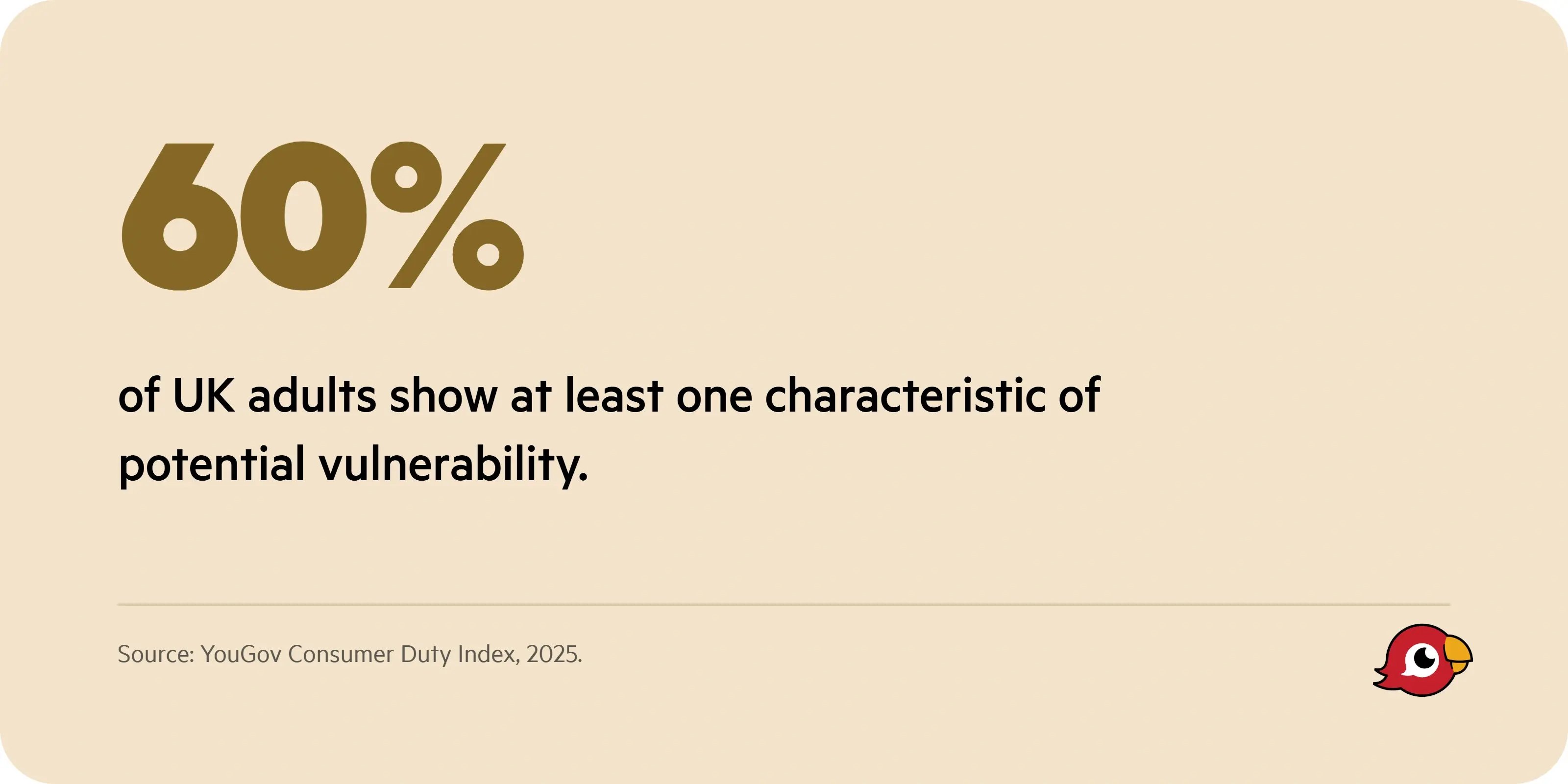
In the UK, 60% of adults show at least one characteristic that could make them potentially vulnerable under the FCA's Consumer Duty, according to YouGov research published in 2025.
The pressure inside the contact center is rising at the same time. In ScorebuddyCX's Quarterly QA & CX Intelligence Pulse, 74% of contact centers said they increased their QA coverage in the last three months, while 58% reported high workload and performance pressure. That pressure lands hardest in exactly the conversations vulnerable customers depend on.
The idea came out of financial services, and that industry still leads the conversation. But vulnerability does not stop at the bank. A grieving spouse calling to close an account. A patient who can't take in the discharge instructions. The trigger differs by industry; the duty of care doesn't.
What makes a customer vulnerable?
A vulnerable customer is someone who, because of their circumstances, faces a higher risk of harm or a worse outcome when they deal with a business.
And when something does go wrong, they're less capable of absorbing it than the average customer.
Vulnerability isn't always permanent, and it's rarely as obvious as you might think. It can be temporary, situational, or tied to a single interaction. Plenty of customers actually won't even know the label applies to them at all.
Our webinar Beyond the Vulnerability Checklist digs into why it surfaces this way, and how agents can recognize it inside a live conversation instead of working from a static list.
Common sources of vulnerability:
- Health factors: mental health conditions, cognitive impairments, physical disability, or illness
- Life events: bereavement, job loss, divorce, or financial hardship
- Capability gaps: low literacy, language barriers, or limited digital skills
- Situational pressure: tight deadlines, acute stress, or an unexpected emergency
Which industries face the highest stakes?
Some sectors carry more risk simply because of what is at stake in the call:
- Financial services
- Healthcare
- Energy and utilities
- Telecom
- Insurance
- Housing and public services
- Travel and other high-stress service environments
That list just sets the scene. If you operate in these sectors, vulnerable interactions show up every day.
The contact center scenarios where vulnerable customers most need care
Empathy and patience belong in every call. A handful of situations raise the stakes sharply:
- Bereavement and loss
- Serious illness or disability
- Mental health and emotional distress
- Financial hardship and debt pressure
- Language and communication barriers
- Fraud, scams, or signs of coercion
- Complex claims, outages, billing disputes, or emergency service needs
The risk is not only human. In regulated industries, failing to support a vulnerable customer can turn into formal complaints, investigations, and fines if consumer protection rules are breached. For a closer look at where those obligations sit, see our call center compliance checklist.
How agents should handle vulnerable customer interactions in practice
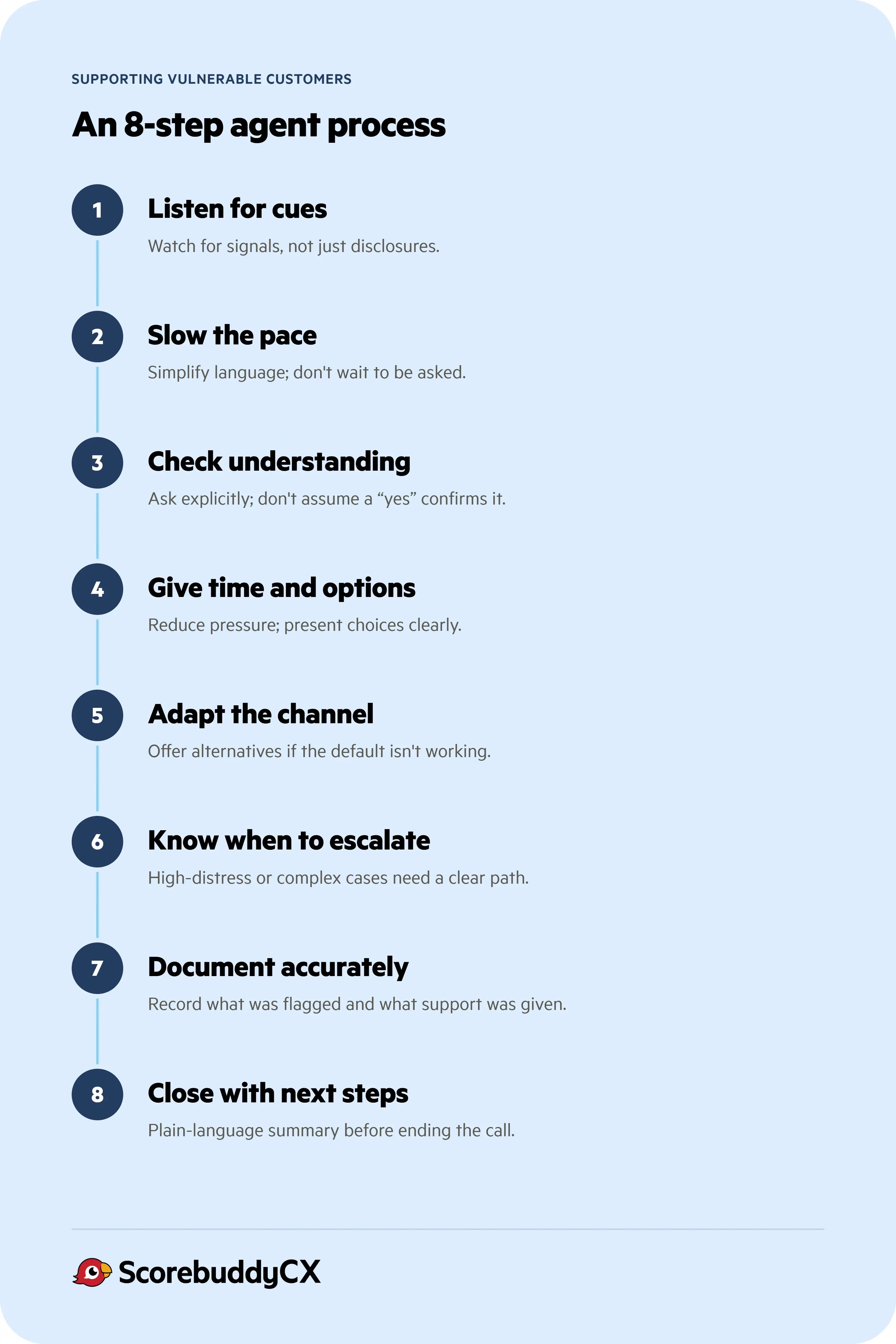
Most of supporting a vulnerable customer comes down to what the agent does in the next few minutes. Eight habits make the difference.
- Listen for cues instead of labels. Sometimes the customer tells you outright that they lost their job or had a diagnosis. More often you have to pick it up: emotional language, confusion, hesitation, details that don't line up, or a third call about the same problem.
- Slow down and simplify. Low literacy and language barriers are common sources of vulnerability, so how you speak matters as much as what you say. Drop the jargon, explain the thing twice if you need to, and ease off the pace.
- Check understanding instead of assuming it. Confirm the customer is still with you. "Does that make sense?" and "Want me to go over that again?" cost nothing and catch a lot.
- Give time and give options. Vulnerable customers often feel cornered. A couple of clear choices and the room to decide takes the pressure off and leads to a decision they can actually live with.
- Adapt the channel or the process. If you work in one of the higher-stakes sectors above, build in flexibility: simpler digital steps, a second contact channel, or more give in billing policy where it's warranted.
- Know when to escalate. Some cases sit beyond standard support, like complex financial, housing, or health issues, or a customer in real distress. Route those to a manager or a specialist team rather than improvising.
- Record needs clearly. Log the interaction in the CRM: the signs of vulnerability, the support given, and any adjustments agreed. The next agent picks up where you left off, and the customer doesn't have to relive it.
- Close with clear next steps. End every call with a plain summary: what you covered, what happens next and by when, and who to contact with questions. This is good practice for any customer and essential for this one.
Example: supporting a financially vulnerable customer
A customer calls the billing line, worried they can't cover their next few payments after a sudden drop in income.
The agent acknowledges it, offers some sympathy, and walks through the upcoming charges clearly before checking the customer has followed. Together they look at alternatives, and the customer agrees to a three-month installment plan.
The agent confirms the next billing date and the support available if things change, then asks whether anything else is worrying them. Because the customer prefers email, the agent sets up a reminder three days before the payment is due and points them to the support inbox for any follow-up.
Finally, the agent flags the account for potential vulnerability in the CRM, notes why the billing flexibility was offered, and recommends a quick review at the next contact. No escalation needed this time.
What good vulnerable customer support looks like operationally
Agent instinct is a start. It won't scale on its own. To make support consistent, you have to build it into how the operation runs and how QA works. Every vulnerable customer is different, but how your team responds shouldn't be left to guesswork.
Clear definitions and escalation rules
No agent will recognize every form of vulnerability, and you can't expect them to. What you can do is give frontline staff a working definition of what to look for, and escalation rules that spell out when and how to bring in a supervisor or specialist team.
Flexible policies over rigid scripts
Scripts have their place. A rigid one falls apart the moment a customer needs more time, more empathy, or plainer language. Give agents room to adapt within sensible limits, and back it with flexible policies, like adjustable payment terms or alternative communication channels, that account for real life.
Strong collaboration between QA, training, compliance, and ops
Vulnerable customer support holds together when QA, training, compliance, and operations actually talk to each other. With the right integrations, QA spots the patterns and the gaps, training turns them into better habits, compliance confirms the bar is met, and the whole thing scales instead of living in one team's head.
Documented support pathways for sensitive cases
When a sensitive case lands, the agent shouldn't be inventing a process on the spot. Document the pathways in advance. A customer who is frightened or angry needs the issue handled quickly and well, and a clear pathway is what makes that possible under pressure.
How QA should evaluate vulnerable customer conversations
If you operate in a higher-stakes sector, your scorecard needs to look past standard service metrics. Build in sections for the behaviors that actually protect a vulnerable customer: empathy, clear communication, checking understanding, sensible flexibility, accurate documentation, and quality of escalation.
Then separate the serious failures from the minor ones. Missing obvious signs of distress, failing to escalate, or giving a vulnerable customer wrong information are high-risk failures. A slightly off tone or a small process slip is a standard service miss. Scoring them the same way hides the problems that matter. You can reinforce this with our QA checklist template.
QA scorecard example
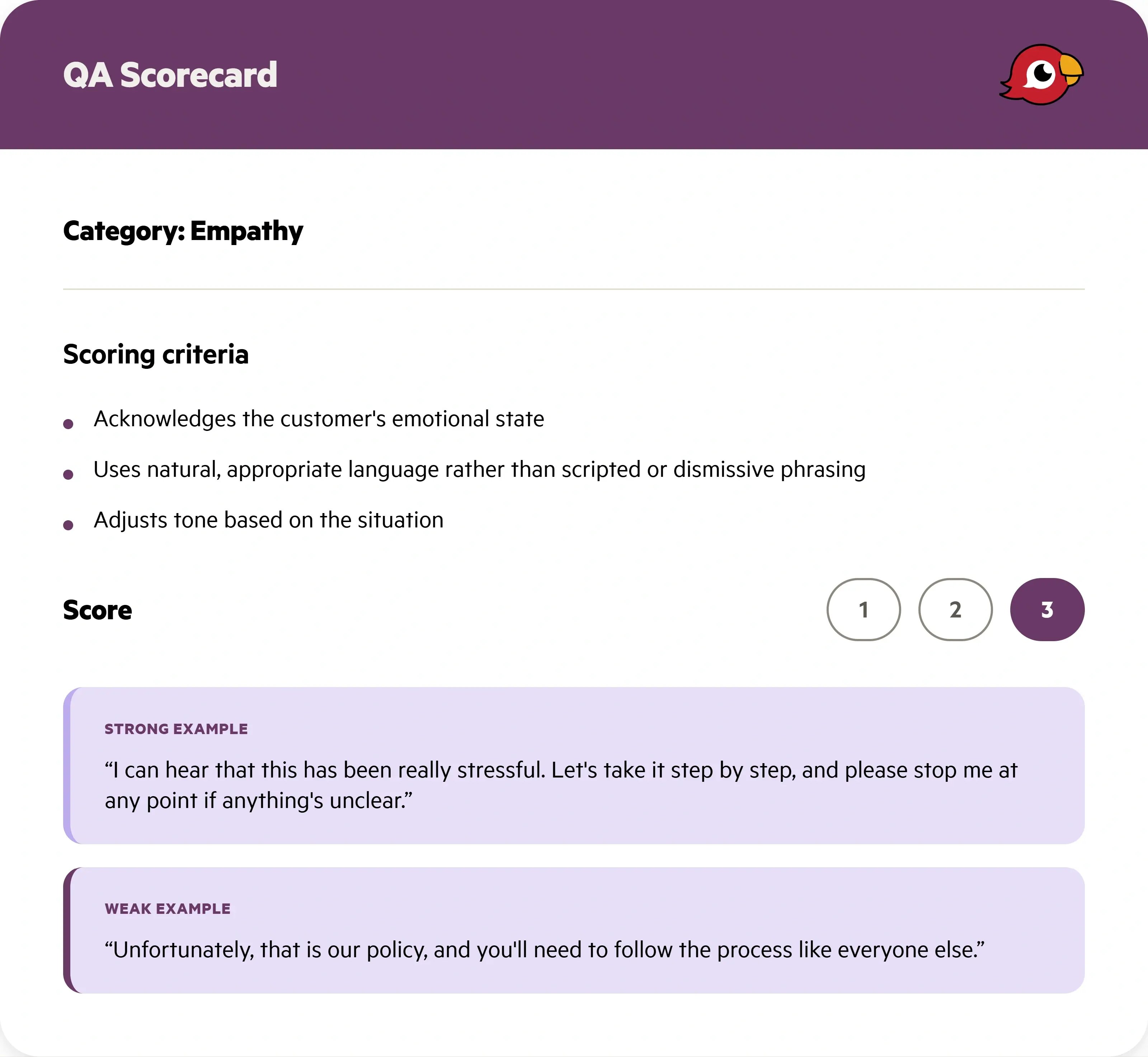
Say you want to track empathy. A well-built scorecard section might look like this:
Category: Empathy
Scoring criteria:
- Acknowledges the customer's emotional state
- Uses natural language, not scripted or dismissive
- Adjusts tone to the situation
Score: 1 to 3
Pair the score with examples so evaluators grade the same way:
Strong: "I can hear this has been really stressful. Let's take it step by step, and stop me any time something isn't clear."
Weak: "That's our policy, I'm afraid, so you'll need to follow the same process as everyone else."
Stuck on what good sounds like? Our roundup of customer service empathy statements gives agents ready phrases they can adapt to the moment.
Coaching and training for vulnerable customer handling
Scorecards tell you where agents stand. Coaching is what moves them. In our Quarterly QA & CX Intelligence Pulse, 85% of professionals agreed that coaching remains the most effective driver of measurable performance improvement.
For vulnerable customer handling, the most effective coaching is scenario-based: realistic situations agents actually face, so they practice judgment instead of memorizing lines.
Building confidence through coaching is what lets an agent stay with a hard, off-script conversation instead of freezing or escalating on reflex.
Example: training agents on empathy and clarity
Okay: Walk the team through the empathy and clarity criteria on the scorecard and explain what each one means.
Better: Let agents hear it. Play real recorded calls across different situations, run role-plays, and ask them to remember a time they, or someone close to them, were in vulnerable circumstances, and how they would have wanted to be treated.
Ad hoc coaching tends to fall short here. Our call center coaching plan lays out a more structured, repeatable approach.
Where AI and analytics can help, without replacing human judgment
Vulnerable customers are the clearest case for why AI won't replace your agents. The sensitive calls, the ones that need a person to read the room: those stay human.
What AI does change is reach. Conversation analytics can cover every interaction instead of a sample, and surface the at-risk ones fast, so a distressed customer or a missed process step gets attention while it still matters. Patterns in complaints, sentiment, and dropped steps come up automatically through speech analytics, which means your QA team reviews far more of the right interactions with the context to act on them.
This is not hypothetical. AI in QA is now mainstream: in our Quarterly QA & CX Intelligence Pulse, 56% of organizations said they rely on AI for most evaluations or as a core part of QA. And the reach is real.
With AI Auto Scoring, ScorebuddyCX customer Intercom can automatically evaluate up to 100% of its interactions, the difference between catching a vulnerable customer's call and hoping it lands in your sample.
How to measure whether your approach is working
You'll know the approach is working when the numbers move in the right direction. A short checklist to run against:
- Fewer complaints, especially about misunderstandings or lack of support
- Fewer repeat contacts, because issues get resolved properly the first time
- Escalations that are genuinely complex or high-risk, and handled promptly
- Stronger QA scores on vulnerability-specific behaviors like empathy, clear communication, and flexibility
- Improvement after coaching, in both scores and agent confidence
- Cleaner audits, with fewer critical failures and stronger compliance on these interactions
- Better outcomes overall, in resolution quality and customer experience, not just boxes ticked on a scorecard
Building consistent support for vulnerable customers
Supporting vulnerable customers is not a one-off compliance task. For the customer, the gap between a good interaction and a poor one can be the difference between coping and not. Most people are fine with the standard script. Vulnerable customers aren't, and there are more of them every year.
The contact centers that do this well build for it ahead of time: clear definitions, structured escalation, flexible policies, and QA and coaching that pull in the same direction. And they give agents the confidence to use all of it in a live call without freezing or hiding behind process.
Do that, and the results follow: fewer repeat contacts, sharper escalations, stronger QA, and better outcomes for customers. You also get something harder to measure: customers who felt understood at the exact moment they needed it.
ScorebuddyCX brings coverage, analytics, and coaching into one closed loop, so the conversations where vulnerability shows up get seen, scored, and acted on. Book a demo and we'll show you how it works on the calls that matter most.