





Most quality programs were built to answer one question: Did the agent handle that conversation properly?
That's a simplified view of QA, yes, but for years this was the core question teams wanted us to help them answer.
When we speak to them now, the question has changed.
They want to know what their customers are telling them, and what the business should do about it. That move, from QA to CX intelligence, is worth understanding properly, because it changes what a quality program is for and who it belongs to.
It's also not as straightforward as some would have you believe. Our own research says so, and I'd rather start there than with a story about how far the industry has come.
How AI changed what's possible
Customer expectations went up and interaction volumes went with them. No big surprise there.
What changed was the mindset around these interactions. The advent of AI in the quality assurance space brought about a realization that these conversations are the most direct evidence a business has about its customers. And what's more, almost none of this conversation data was going anywhere useful.
Quality teams felt this first. You can only listen to so many calls in a week. Review two or three per agent per month and the rest go unheard. That's a lot of crucial customer knowledge left undiscovered.
So coverage became the priority, and 74% of contact centers told the first edition of our Quarterly QA & CX Intelligence Pulse they had increased theirs in the last three months, 27% of them significantly.
AI gave us an answer to the coverage problem, maybe faster than a lot of teams were ready for.
What the technology delivered, and what it didn't
You'll have seen the version of this story where you switch AI on, coverage goes to 100%, and the hard part is behind you.
Of course, that's not how it goes in the real world.
The volume promise is true, yes. AI Auto Scoring evaluates up to 100% of conversations across channels such as voice, chat, and email, and the coverage numbers some of our customers are reporting were genuinely out of reach just a few years ago.
What the technology doesn't do is arrive pre-trusted or run itself. Getting scores you can defend takes configuration, calibration, documentation, and people who know what a good evaluation looks like. Get the governance wrong and it's very hard to distinguish which output is worth acting on.
The upcoming second edition of the Pulse asked about this directly. Of contact centers using AI to evaluate interactions, only 14% say those scores are always reviewed or challenged by a human. The people being evaluated are the least convinced of all: 38% of agents say they don't trust AI-generated QA scores, against 19% of managers.
We run this research every quarter because the gap between the pitch and the reality is often where the most useful information sits.
Trust is what decides whether a score changes anything. If nobody ever reviews AI scores and the agents don't trust them, then that expanded coverage doesn't mean much.
Where the insight has to go
Coverage on its own gives you a much bigger pile of scores.
The value turns up when what's inside those conversations reaches the people who can act on it, and most of them don't work in your contact center. Customers spend those calls and chats explaining why they got in touch, what confused them, which part of the product they couldn't find and, though they might not say so directly, what nearly made them leave.
None of that is strictly contact center information. But it arrives through the contact center, and then, in most organizations, doesn't go any further.
Consider who else has been waiting for it. Product teams are working out which feature creates the confusion, usually from tickets and guesswork, when the answer is sitting in a few hundred calls nobody has read. Marketing would learn much more from the words customers actually use over another round of message testing. Operations and risk are downstream of the same thing: the contact drivers and the process breakdowns behind them, and the exposure that only surfaces when somebody happens to sample the right call.
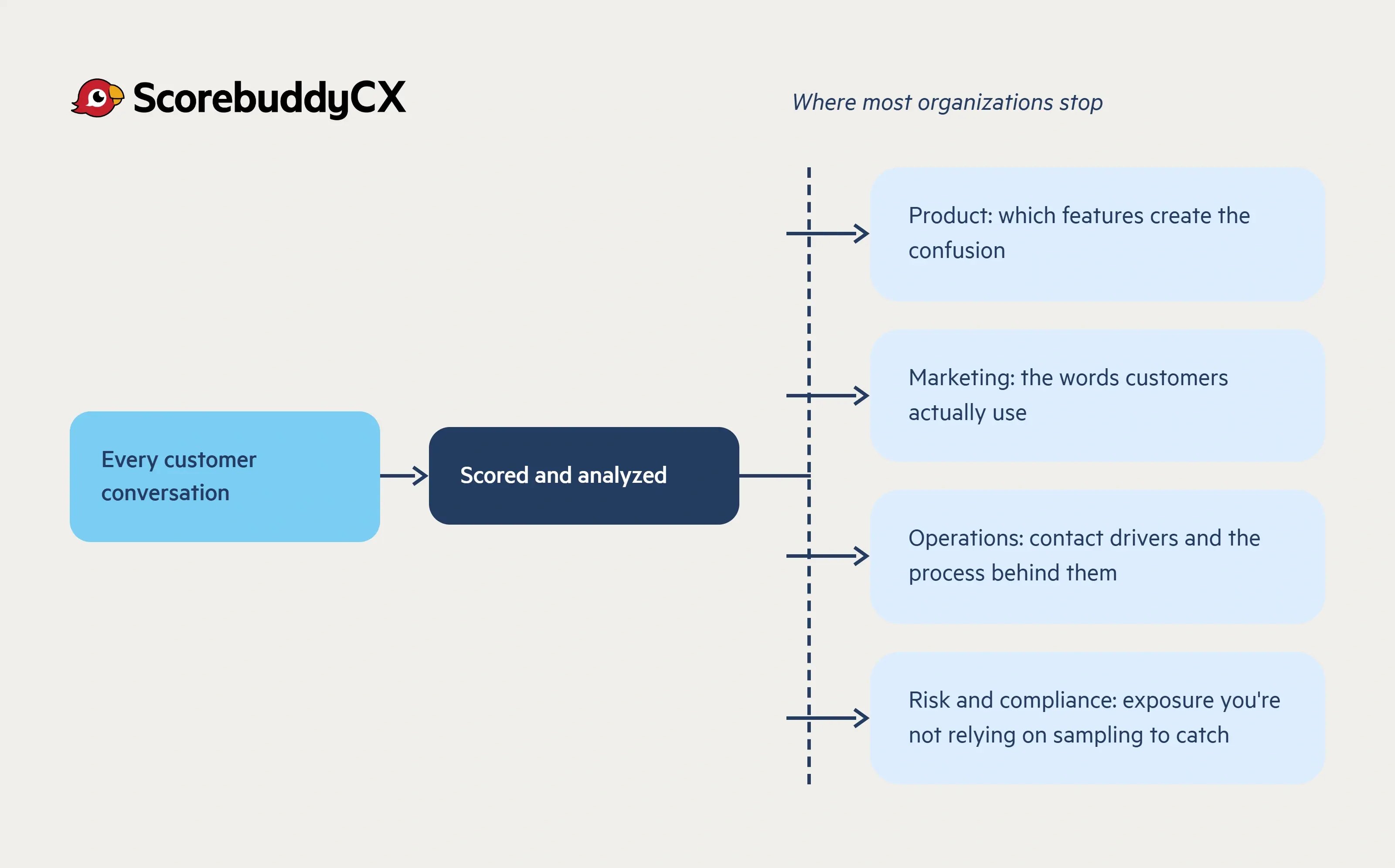
Handled properly, conversation data becomes the closest thing a business has to a record of what its customers really said, rather than what a survey sample said about it weeks later. That's the whole argument for conversation analytics, and it's why the reporting matters as much as the scoring: business intelligence is what gets a finding in front of someone who can do something with it.
If the idea of CX intelligence itself is new to you, we've written separately on what conversation intelligence is and who it's for.
Quality assurance underneath all of it
If you run quality, this can read like your function being absorbed into something bigger. I'd argue it goes the other way.
QA is the engine. Everything downstream depends on conversations being evaluated accurately and consistently, against standards somebody thought hard about. Feed CX intelligence bad scores and you get untested information reaching every department in the business.
What changes is where the time goes. Less of it spent on scoring, and more on what those thousands of scores add up to: the patterns worth escalating, and the calibration and governance that keep the whole thing honest, including the call on which AI output gets trusted and which gets checked by a person. That's a more strategic job than the one most QA managers were hired into.
Of course, coaching is still where performance really changes. 85% of professionals in the first edition of the Pulse research say it remains the most effective driver of measurable improvement, and wider coverage mostly means there's more to coach on and better evidence to do it with.
How we got here, and what it means for you
We started as a QA scoring platform. That's still the foundation, and more than 300 organizations across 25+ countries run their quality programs on it, reporting 60%+ reductions in manual QA workload with AI Auto Scoring accuracy above 90%.
But scoring was only ever going to be one part of it. So conversation analytics, business intelligence, coaching, and learning went into the same platform, and the name changed to match what we'd built. That was a decision about where this is heading rather than a description of where every contact center is today.
The difference it makes is real, and it takes a couple of quarters to earn. None of it removes the need for experienced judgment.
The part I'd watch is the last mile. Some organizations will get to full coverage and stop there, with the insight sitting in a dashboard the rest of the business never looks at. So when you're weighing this up, ask where the findings go after they're produced, and whether anyone outside the contact center has been told what to do with them. Coverage is the part every vendor can demonstrate. What happens to the insight afterward is where the return actually comes from.
See how ScorebuddyCX turns conversations into insight the whole business can use.