




At CCW Amsterdam, most stands on the show floor were selling a fix for one part of CX. A faster QA workflow, a smarter bot, a sharper sentiment score... All useful, of course, but every one of them asks you to shape your priorities around whatever that solution happens to measure.
The leaders who stopped by our stand already had tools (maybe even too many tools, in some cases!). What they were really looking for was one reliable view of their conversations so they could decide where to act based on their own real-world data.
If you were to boil it down, that's probably the core idea behind CX intelligence: you score every conversation you can, let the evidence show you which part of your customer experience needs work first, then use the insights arising from all your conversation data to make those fixes.
We've written before about the shift from QA to CX intelligence. So rather than repeat the definitions, let's get practical in this article: five things we heard over the three days at CCW Amsterdam, and what to do about each one.
| What we heard | What to do |
|---|---|
| Most vendors sell a fix for one part of CX | Check what your conversations show and decide what needs fixing based on them |
| Coverage is no longer the hard part | Decide what the extra coverage is for |
| AI scores only matter if people trust them | Calibrate AI scoring against your own evaluators |
| Insight stops at the QA report | Connect scoring to coaching in the same platform |
| Bots and agents are judged by different rules | Hold every conversation to one quality bar |
Five things we kept hearing at CCW Amsterdam
1. Most vendors sell a fix for one part of CX
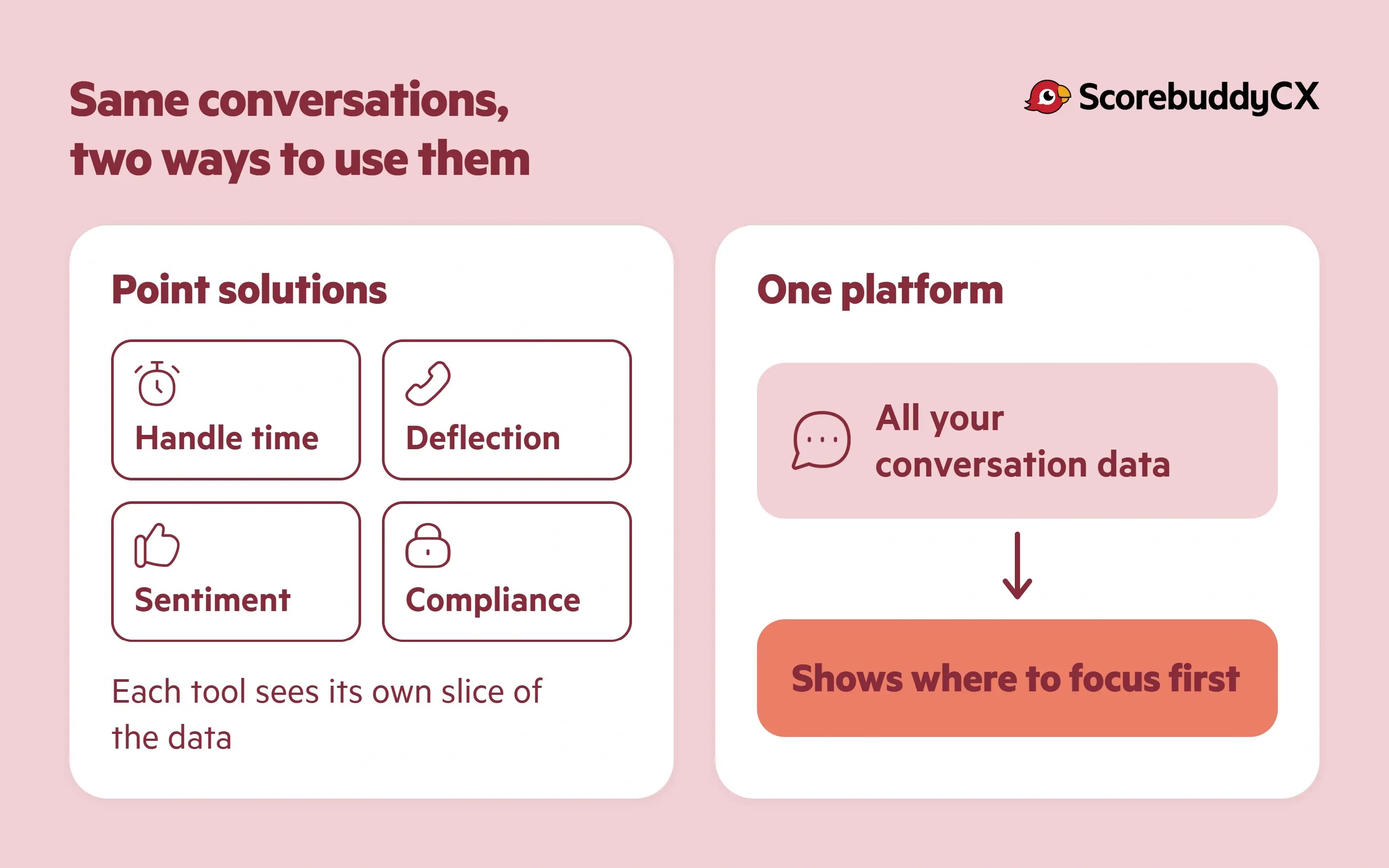
Walk any contact center show floor and you'll find a point solution for almost every step of the customer journey, each promising to improve its own corner: handle time, deflection, sentiment, compliance. The trouble starts when you buy several and try to Frankenstein them together. Every tool keeps its own slice of the data behind its own dashboard, and nobody is seeing the whole customer journey.
If you were in Amsterdam, you might have seen the message plastered across our stand: "Automating QA is just the start. Bring CX intelligence business-wide." That's the approach we're taking with our platform. Scoring every conversation is step one. The value comes from what the business does with the patterns it finds.
What to do: Before your next vendor conversation, gather the evidence you already have. Complaint logs, repeat-contact rates, CSAT comments, and your QA results will give you a starting point, even if they only cover a small sample. Pick the part of CX the evidence points to, then ask every vendor the same question: how would your platform help us improve that, and can it use all of our conversation data to do it?
2. Coverage is no longer the hard part
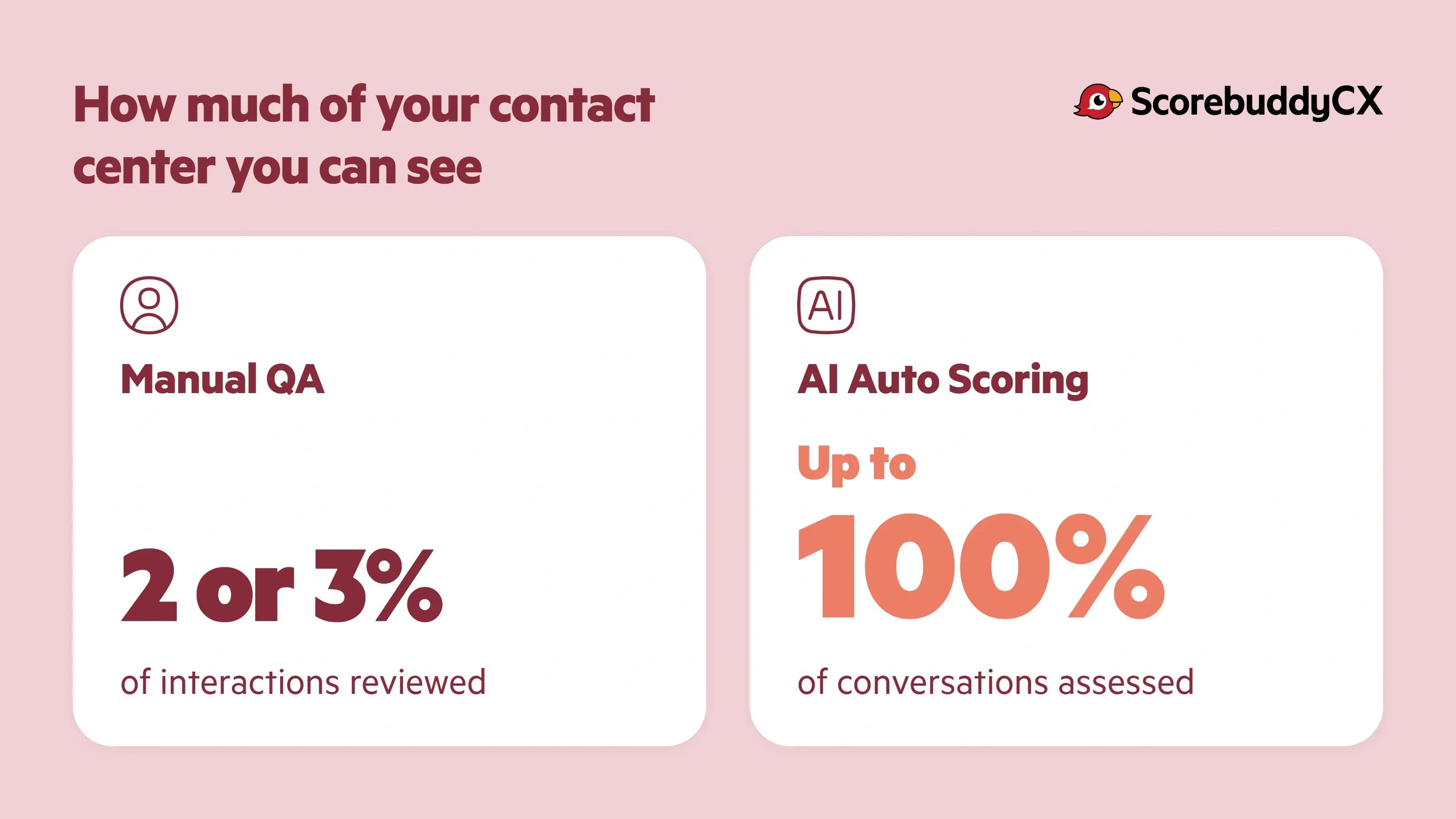
For years, the limit on QA was capacity. A manual QA program reviews 2 or 3% of interactions in a typical contact center, which leaves you guessing where the real problems are. We've all seen how fast AI scoring is changing that.
Once AI Auto Scoring can assess up to 100% of your conversations, the question changes from "can we see enough?" to "well, now that we can see everything, what do we do with all the data?" It's also where your priority comes from. With every conversation scored, the patterns that were once hidden in the interactions nobody had time to review start to emerge.
What to do: Tie your coverage target to a business outcome. If compliance risk is what the data shows first, set scorecards that flag every risk conversation. If it's repeat contacts, track the drivers behind them. Coverage without a purpose just gives you a bigger report to dig through.
3. AI scores only matter if people trust them
Several conversations at the stand turned up the same worry. An AI evaluator can score thousands of conversations, yes, but how do you know it's scoring them the way your best human evaluators would? An AI score nobody trusts will be ignored by supervisors and disputed by agents.
Our AI Reality Check report shows the gap:
- 76% of contact center managers trust AI-generated QA scores, but only 57% of the agents being scored do.
- Among contact centers using AI evaluation, 14% always have a human review or challenge those scores, and 39% often do.
- For the other 47%, human review happens only sometimes, rarely, or never.
Trust must be built through work, with calibration and human oversight. At ScorebuddyCX, calibration rounds tune your scorecards against your human evaluators, which is where building trust in AI QA scores starts. Your team can then layer human review onto the conversations that need judgment and decide how often a human should review them.
What to do: Before you scale AI scoring, run a calibration round. Have your evaluators and the AI score the same set of conversations, compare where they differ, and keep tweaking until the gap is small enough to get that trust in place.
Want the numbers behind trust, human review, and coaching? The AI Reality Check, part of our quarterly QA & CX Pulse report series, surveyed 600 contact center professionals on what AI has changed in their operations. Read the AI Reality Check report
4. Insight stops at the QA report
A score on its own doesn't change anything. The leaders who got the most from QA were the ones whose insight reached the people who could act on it: agents through coaching, operations through root cause analysis, and product teams through evidence of what customers keep asking about.
Our AI Reality Check report shows how often that hand-off fails. Among contact centers generating AI insight, only 18% of coaching conversations are triggered by it on average, and 15% get no coaching out of it at all.
When scoring, analytics, and coaching live in separate tools, the hand-off breaks. The finding sits in a silo, and the coaching session happens weeks later, if at all. ScorebuddyCX brings scoring, coaching, and learning into the same platform, so a pattern found on Monday can turn into agent coaching that same week.
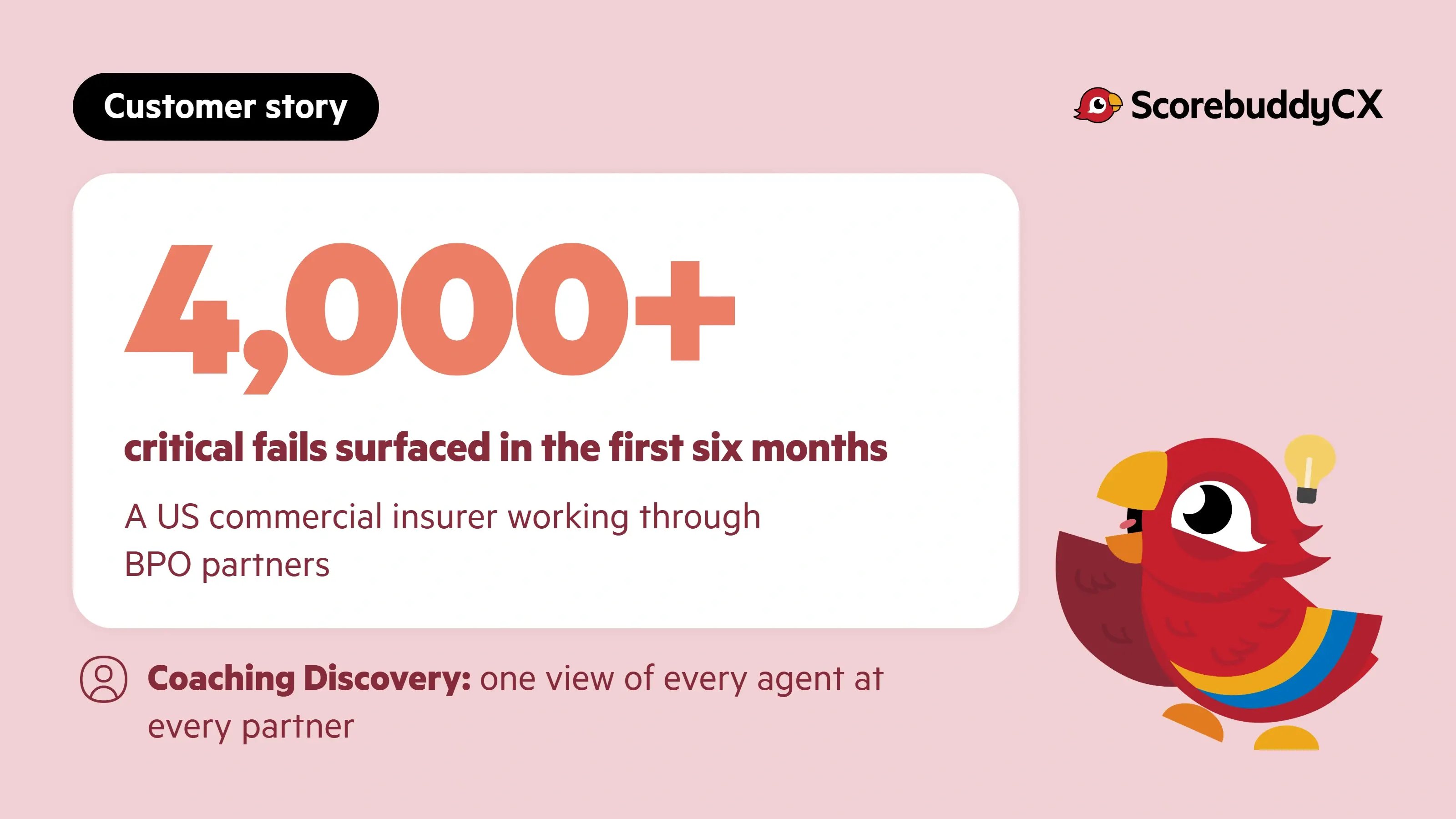
One of our customers, a US commercial insurer working through BPO partners, was struggling to see agent performance across those partners in one place. Our Coaching Discovery feature gave them a single view of every agent at every partner, filtered down to critical fails.
In the first six months, it surfaced more than 4,000 critical fails that would otherwise have stayed hidden in each BPO's own numbers. Each of those points to one agent in one conversation, which is exactly where a coaching session starts.
What to do: Pick one recurring issue from last month's QA results and follow it all the way through: who was coached, what changed, and how you measured it. If you can't trace it end to end, that gap is the first thing to fix.
5. Bots and agents are judged by different rules
More contact centers now resolve a share of contacts with chatbots and AI agents. Yet in many teams, human conversations go through QA while bot conversations are measured only on containment or deflection. Customers don't experience the two separately, so it doesn't make sense that quality should be measured separately either.
Bots may also be doing less on their own than you'd expect. Respondents to our AI Reality Check report say AI chat and voice bots only fully resolve 19% of customer queries on average, without a human involved at any point.
We let you score agent and bot conversations in the same platform, on either a shared scorecard or on custom scorecards built specifically for your bots. That gives you one view of service quality, however the customer was served.
What to do: Take 10 bot conversations and 10 agent conversations on the same topic and score them against the same standard. Where the bot falls short, you've found your next improvement, and the evidence picked it for you.
How to choose the part of CX to focus on first
Once every conversation is visible, the hardest decision is where to start. The data will usually surface more than one candidate: compliance gaps, repeat contacts, customer effort, vulnerable customer handling, coaching quality. For each one, ask three questions:
- Evidence: do your conversations show the problem clearly enough to measure it?
- Impact: what is it costing you today, in complaints, risk, repeat contacts, or churn?
- Ownership: is there a named leader who will act on what the data shows?
Start with the priority that scores well on all three. When that number improves, go back to the same data and pick the next one, without adding another tool. That's what we mean by a bird's eye view: you can see every conversation, so you decide what to improve next.
The takeaway from CCW Amsterdam
The show floor was full of tools built to fix one problem each. That works until your conversations point to a problem the tool wasn't built to measure, and then you're shopping for another one. The leaders we met wanted something bigger: to see all of their conversation data, find their CX priorities in their own evidence, and work through them on their own terms. Next time you talk to a vendor, ask what their tool does when your data leads somewhere new.
Missed us at the stand? Our AI Reality Check report surveyed 600 contact center professionals in the UK and US on what AI has actually changed, from headcount to trust in AI scores, human review, and coaching. Get the report here.
ScorebuddyCX combines AI Auto Scoring for up to 100% of conversations, configurable scorecards, conversation analytics, and integrated coaching in one platform, trusted by teams at Allianz, Autotrader, Capita, CarTrawler, Intercom, TikTok, and plenty more. Book a demo and see how it finds what to fix first.