



A policyholder calls to say they lost their job last week and cannot pay this month's premium. Your agent has two scripts in front of them. One offers forbearance, points to the hardship process, and documents the conversation. The other is the regular collections flow. Pick the wrong one and you have a conduct failure a regulator can act on, and if your QA team is reviewing two percent of calls, you will probably never hear it.
Insurance calls carry duties that attach the moment something is said, often in a single sentence from the customer. The only place those duties get evidenced, after the fact, is QA.
In short
- Insurance QA is conduct QA. Tone and resolution matter, but the scorecard's real work is checking regulatory duties on claims, servicing, and sales.
- The rules split by market and by line. US carriers answer to state regulators and unfair claims practices rules. UK firms answer to FCA Consumer Duty, ICOBS, and the IDD, and Irish firms to the Central Bank of Ireland's Consumer Protection Code.
- A 2% sample cannot evidence conduct. AI scoring takes coverage up to 100% of interactions, after the interaction, so the risky calls surface themselves.
- QA surfaces, evidences, and routes. It produces the audit trail a regulator asks for. It does not make the carrier compliant on its own, and anyone selling you that is overpromising.
Why insurance QA is a heavier job than retail QA
An insurance QA scorecard has rows a retail one doesn't. "Did the agent explain the no-fault deadline?" "Was forbearance offered?" "Did the agent verify identity before discussing the policy with the daughter who called?"
The failure modes are regulatory, not experiential. A flat greeting is a coaching note. A missed disclosure on a cancellation call is something a state regulator can open a file on. Same contact center, same seven-minute conversation, completely different stakes.
The mechanics are the same as any contact center compliance QA program, scorecards, calibration, coaching. The difference is the criteria. A general QA program asks whether the agent sounded helpful. An insurance program also asks whether the agent met a legal duty you can name and point to.
Which rules actually bite on a call (and whose)
You don't need the full regulatory textbook to run insurance QA. You need to know which rules show up on calls, and in whose jurisdiction:
| Market | Framework | What it governs on a call |
|---|---|---|
| US (state-regulated) | Unfair claims settlement practices rules | Acknowledge promptly, assist the claimant, explain delays, don't misrepresent policy terms |
| US | No-fault and injury rules | Notice and application deadlines the claimant must be told about |
| US | Cancellation and non-renewal statutes | Permitted reasons, notice periods, what the notice must say |
| US | GLBA and FCRA | Privacy of financial information, and the rules on credit-based decisions |
| UK | FCA Consumer Duty | Good customer outcomes, avoiding foreseeable harm, supporting vulnerable customers |
| UK | ICOBS and the IDD | Conduct of insurance business, plus demands-and-needs and suitability at point of sale |
| Ireland | Central Bank of Ireland Consumer Protection Code | Acting in the customer's best interests, suitability, clear information, and support for consumers in vulnerable circumstances |
One thing worth being plain about: call recording consent and dialer rules like the TCPA are a legal and telephony setup. Your dialer handles them. QA checks what happened inside the conversation once it was connected. Different jobs, often conflated.
The sixty seconds where most of the risk lives
Most regulatory duties announce themselves in the customer's own words, in the first sixty seconds. A scorecard that maps those moments to specific criteria turns a legal duty into something an evaluator (or an AI) can actually score.
| Line | What the customer says | The duty it triggers | What QA scores |
|---|---|---|---|
| Claims, first notice of loss | "I need to report an accident", "my basement flooded" | Acknowledge, assist, explain next steps | Was the duty to assist met? Were the timelines explained? |
| Claims, injury | "Someone was hurt" | Explain benefits, explain deadlines, handle health details under the carrier's own privacy rules | Were deadlines explained? Was identity verified before any detail was shared? |
| Claims, delay | "Nobody has called me back" | Acknowledge and give a stated reason for the delay | Was the delay acknowledged? Was a reason given? |
| Servicing, non-payment | "I can't pay this month" | Follow the notice rules before any cancellation for non-payment | Were the notice steps followed? Was hardship offered? |
| Servicing, non-renewal | "Why are you dropping me?" | Give reasons and notice that match what the statute permits | Were the reasons given? Was the notice period correct? |
| Servicing, third-party | "I'm calling for my mother" | Verify identity, apply privacy rules before any disclosure | Was the caller verified? Was anything disclosed before verification? |
| Sales | A product gets recommended | Match to demands and needs, make required disclosures | Was suitability established? Were the disclosures made? |
One note on the health line, because it gets mishandled. When a claimant mentions an injury or a condition, the privacy obligations on that information are the carrier's, not the QA platform's. QA checks the agent's conduct around it: was verification done, were deadlines explained. The scorecard doesn't process the health detail itself, and this is not a route to HIPAA compliance on a health insurance line.
Trigger, conduct, omission: The three things a scorecard is actually looking for
Underneath every row in that table, regulated interactions turn on one of three things. Naming them stops the scorecard from reading as a scattered list of special cases.
Trigger
Something the customer discloses that starts an obligation. A loss. An injury. A redundancy. The duty attaches the moment it is said, whether the agent spotted it or not. That's what QA is there to check.
Conduct
Something the agent said or did that crossed a line. Pressure selling. Promising something the firm cannot do. Giving information to a caller who was never verified. Conduct is fully present in the transcript.
Omission
Something the agent should have said or done and did not. The disclosure that never happened. The signposting to support. The forbearance never offered. The verification step skipped. The transcript shows an omission as clearly as it shows conduct.
Not every signal belongs in the same workflow
Not every signal can be judged from the conversation alone, and the workflow should follow the evidence rather than force every criterion down the same pipe.
| Signal | Is it all in the transcript? | Where it routes |
|---|---|---|
| Trigger | Usually needs a second system to prove the right action followed | Human in the loop. AI builds the worklist, a person checks the CRM or the case file |
| Conduct | Yes. What was said is what was said | AI can score it end to end |
| Omission | Yes. The absence is in the transcript | AI can score it end to end |
Take the redundancy example from the top. The disclosure is in the conversation, but proving the agent then reassessed affordability and offered forbearance usually means looking at a system the call doesn't show. AI flags the trigger; a human closes it against the record. Conduct and omission (did the disclosure happen, was the caller verified, was pressure applied) are complete inside the transcript and can run at volume.
Writing an insurance QA scorecard a regulator can actually read back to you
A compliance scorecard earns its keep when every regulatory duty maps to a specific, observable, pass-or-fail criterion. "Did the agent comply with Consumer Duty?" is not a scorecard question. "Did the agent offer at least one hardship option to a customer who disclosed financial difficulty?" is. The first is a vibe. The second is something an evaluator can score consistently and a regulator can read back to you.
Build the scorecard from the duties above, then make the harder decision: how to weight them.
Two camps here. One weights compliance heavily, so a missed disclosure drops the agent's score the way its risk deserves. This is popular where QA reports into risk or compliance, and the point is to make the stakes visible on every call.
The other runs the compliance questions at zero weight. They still get asked, they still build a filterable list of risky interactions, but they don't distort the agent's quality average. This is popular where QA reports into operations, and the point is to keep agent performance clean while giving compliance its own view.
Both are defensible. The choice is about where compliance lives in your reporting, not whether it gets checked. A scorecard template is a reasonable place to see the structure before adapting it to your frameworks.
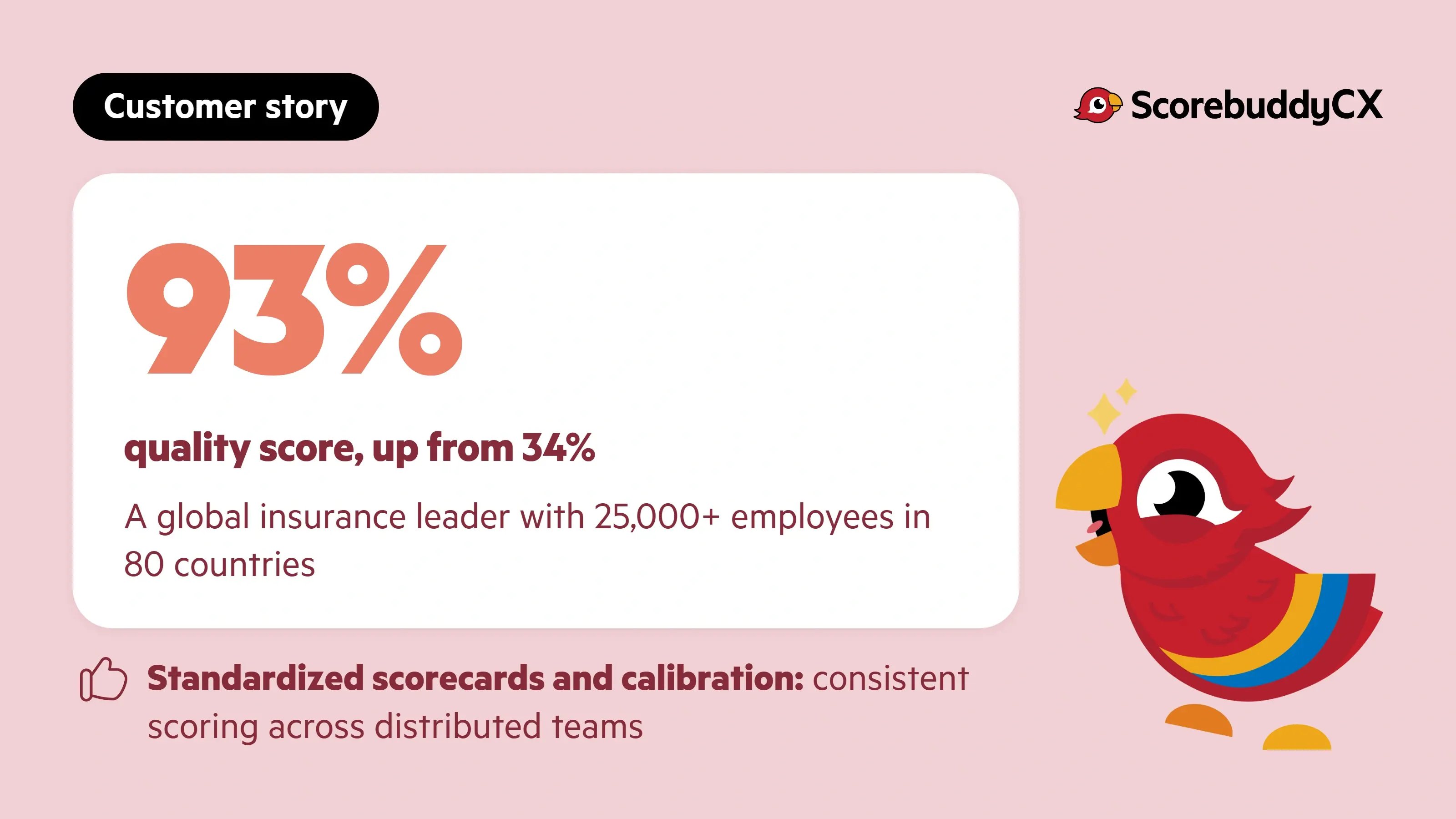
A shared structure also keeps scoring consistent across teams and sites. When one of our customers, a global insurance leader, standardized its scorecards and calibrated evaluators across distributed teams, it raised quality scores from 34% to 93%.
Resist turning the whole thing into a general "compliance" score with a tick-box underneath. Regulators read specific duties against specific calls. So should you.
The two percent problem nobody wants on a slide
You're evidencing a regulatory population with a sample. A hundred thousand calls a quarter, two thousand reviewed. The other ninety-eight thousand are regulated interactions your QA process does not touch.
A regulator who asks "show me how you monitor conduct on your claims line" is not going to be reassured by that.
AI scoring closes the gap. The compliance questions run across up to 100% of interactions, after the interaction, and the answers become a filterable list of the calls that expose risk, not a random spin of the roulette wheel. Human evaluators then deep-dive where their judgment counts, instead of spending the week on randomly sampled calls where nothing happened.
Scoring calibrates to 90% or higher against human benchmarks once the criteria are tuned. That tuning is the work, and it is non-negotiable. Anyone promising perfect first-pass accuracy on a regulatory scorecard is lying to you. What a good vendor shows is the curve, round by round, as prompts sharpen and false positives get knocked out.
Two limits worth stating out loud: the platform reads the interaction, not the CRM or payment system, which is why trigger checks route to a human. And it surfaces, evidences, and routes regulatory risk. It doesn't make a carrier compliant. The compliance program is still yours. QA makes it provable.
ScorebuddyCX: The evidence layer underneath your compliance program
Everything above sounds workable in principle. In practice, most insurance QA teams struggle because compliance lives inside a scorecard that only ever runs against a two percent sample, evaluators and reporting are stitched together manually across regions and frameworks, and the audit evidence a regulator actually wants is scattered across spreadsheets nobody owns.
The biggest barrier to running a defensible QA program in insurance is a lack of coverage in the compliance monitoring that sits underneath it, and no amount of coaching, scorecard tuning, or reporting discipline fixes that gap on its own.
ScorebuddyCX is the QA and compliance evidence layer that closes it.
By scoring up to 100% of regulated interactions against your own frameworks, ScorebuddyCX turns a sample-based QA program into a defensible evidence trail your risk, operations, and audit teams can all rely on. The platform provides:
- Compliance monitoring at scale: The compliance questions run across up to 100% of interactions, after the interaction, so each scored call carries an answer tied to a specific duty. That's the shift from sampled assurance to defensible evidence, and it's what mitigating regulatory risk looks like inside an insurance operation.
- Scalable QA without scaling headcount: Scoring moves off the evaluator's plate so they stop sampling randomly and start deep-diving on the calls that actually carry risk. Automating QA at the volume end and scaling the review model are the same lever read two ways.
- A closed coaching loop that moves scores: A failed score can lead to an assigned 1:1 through in-app coaching, a targeted course through the Learning Management System, and a formal right for the agent to challenge a score through agent engagement. That's the loop that moves AHT, FCR, and policy retention, not just the compliance column.
- The strategic layer underneath the metric: Conversation Analytics surfaces what customers are actually calling about and why. Voice of the customer shows which themes are driving satisfaction up and which are dragging it down. Customer experience work turns that into CSAT, FCR, and retention outcomes instead of three separate dashboards.
- Bot governance in the same platform: When your bots handle first notice of loss, the duty-to-assist rules don't care that a human didn't answer. QA for Bots scores your AI agents in the same platform, on a shared scorecard or on scorecards built for your bots, so disclosure, escalation, and hallucination checks sit in one evidence trail.
- Stack-fit, not stack-replacement: ScorebuddyCX doesn't swap out your dialer, your CRM, or your bot platform. Scores, transcripts, and context flow between them through the integrations layer, so one data model covers channels such as voice, chat, and email, plus your bots.
You cannot run a defensible compliance program on top of a two percent sample. Get the evidence layer right first.